

Contact us

Self-esteem and self-confidence are not the same. You can feel capable yet still doubt your worth. Learn the key differences, common signs, and practical ways to build both together.
Most personal-growth advice fails because of one mistake. It treats self-esteem and self-confidence as the same thing. They are not. People use the two words interchangeably in books, podcasts, and Instagram captions, but they point to two different things, and mixing them up is why so much effort changes so little.
The successful professional who looks like they have it all figured out and privately feels worthless is not low on confidence. They are low on self-esteem. The accomplished person who freezes the moment they walk into a party full of strangers is not low on self-esteem. They are low on a specific kind of self-confidence. The same person can have both problems, or only one.
The self esteem vs self confidence difference is the thing to get right first. People search the self esteem vs self confidence question online roughly ten thousand times a month, and the answers they find are usually wrong, vague, or both.
Self-confidence is your belief in your ability to do specific things. Self-esteem is your sense of being worthy as a person, apart from anything you can or cannot do. You build them in different ways, they break for different reasons, and they take different work to repair. Working on the wrong one is why someone can read every confidence book ever written and still feel like a fraud.
This guide covers the real difference between self-esteem and self-confidence, the four combinations of high and low you can end up in, why confusing them stalls most self-improvement, the tactics that build each one, and how to work out which is your real problem right now. No affirmations, no vague advice about loving yourself. Just the difference and what to do about it.
Key Takeaways to Remember
- Self-esteem is your view of your worth as a person. Self-confidence is your belief in your ability to do specific things.
- They sit at different levels and respond to different things.
- You can have one without the other, which is why high achievers can secretly feel worthless.
- Confidence is built through evidence and practice. Self-esteem is built through self-talk, values, and identity work.
- Working on the wrong one is the most common reason personal growth feels stuck.
Self-esteem is the view you hold of your own worth as a person. It is a mostly unconscious verdict that sits underneath how you react to everything around you.
People with healthy self-esteem treat themselves as worthy of respect, kindness, and care. People with low self-esteem treat themselves as worthy only on good days, and deserving of contempt on bad ones.
Psychology Today's overview of self-esteem calls it the global, evaluative dimension of the self, which is the academic way of saying self-esteem is how you grade yourself as a human being overall, not as someone doing any one task.
Self-esteem sits at the level of who you are, so it does not move much when you succeed or fail at a single thing.
A person with healthy self-esteem who flubs a presentation feels disappointed but not diminished. A person with low self-esteem who flubs the same presentation takes it as proof of what they already suspected, that they are not enough.
The same event lands completely differently depending on which self-esteem floor it falls onto.
This is the part almost every popular take on the subject gets wrong. Self-esteem is not built by doing more things. Plenty of accomplished people have low self-esteem.
It changes only when the underlying judgment changes, and that is slow, deeper work that does not respond to motivational quotes or one productive week.
These two terms get used interchangeably and they should not be. Self-worth is the plain fact that you have value as a human being. It is not earned, not conditional, not something you can lose.
Self-esteem is your own read on that worth. The first is a fact. The second is a perception.
The difference matters because it changes the work. If you treat self-esteem as something you have to build from nothing, you sign up for a project with no finish line.
If you treat it as a perception that has drifted away from a worth that was always there, the task gets clearer. You are not building worth. You are cleaning the lens you see it through.
The foundations of self-esteem are laid in childhood, through how you were spoken to, how your needs were handled, and what you absorbed about whether you were lovable, useful, or a burden.
That is why low self-esteem is rarely fixed by a weekend workshop. The patterns behind it were laid down over years, often by people the child could not afford to distrust, and they sit far below conscious thought.
The critic in an adult head is usually an echo of the loudest voice in the childhood home, which is why people who struggle with self-esteem also tend to struggle with overthinking, since that voice does not only judge, it also keeps up a running commentary on every move you make.
Adult life then adds its own layers. Relationships that build you up or wear you down. Jobs that notice you or ignore you. Long runs of success or failure.
These shift self-esteem at the edges but rarely rewrite the foundation. That is why people who seem to have everything can still run on a quiet sense of not being enough. The new evidence never reaches the old wiring.
The practical point is that repairing self-esteem, when the foundation is shaky, often needs therapy rather than coaching.
Coaching can do real work on the adult layer, on getting clear about values, and on the daily choices that build or chip away at self-respect. But when the floor itself is cracked, the work is clinical, not motivational.
Self-confidence is your belief that you can do a specific thing, handle a specific situation, or get through a specific challenge. It is tied to the area you are in, built on evidence, and far quicker to move than self-esteem.
It is close to what researchers call self-efficacy, which Albert Bandura described in the 1970s and which has shaped most serious confidence research since.
The key word there is specific. You do not have one general self-confidence. You have many.
You can be sure of yourself at work and terrified of a party where you know nobody. You can run a team of thirty and freeze when a stranger asks for directions.
The mistake people make is treating confidence as one dial that goes up or down. It is not. It is a row of dials, one per area, and they can read wildly differently in the same person.
This is the part of what is self confidence that almost no popular content gets right. Confidence is not a personality trait.
It is a set of beliefs about what you can handle, each one built on evidence in that area, and each one movable through practice in that area.
Take a couple of examples. A surgeon with thirty years in the operating room can have complete confidence with a scalpel in hand and almost none making small talk at a charity dinner.
A professional dancer can be at ease in front of a thousand strangers and lose their nerve on a first date with someone they actually like.
In both cases the confidence sits exactly where the evidence is. The surgeon has thousands of operations behind them and little to show for social events. The dancer has a stage but not a date.
Confidence follows evidence. Where you have practiced to the point of being good, you feel capable. Where you have not, you do not.
This is why telling someone with low confidence in one area to just believe in themselves does not work. The brain will not hold a belief it has no evidence for, not for long.
The work is not to talk yourself into confidence. It is to build enough evidence in that one area that confidence becomes the obvious conclusion.
Confidence is built almost entirely by stacking up evidence. You try something. You succeed, half succeed, or learn something specific from how it went.
Your brain notes it. Next time you face the same kind of situation, your brain checks back.
The more wins on the record, the more confident you feel going in. That is close to how the brain works out what it can and cannot do.
So confidence comes from practice and exposure in the actual area, not from reading, watching motivational videos, or repeating affirmations.
Telling yourself you are a great public speaker while never speaking in public builds nothing. Speaking in public ten times, seeing what happened, adjusting, and going again builds it.
This is also why confidence is quicker to build than self-esteem when the structure is right.
Twelve weeks of focused practice in one area usually produces visible, lasting change in confidence there. Twelve weeks of self-esteem work shows far less, because the level it works on is deeper.
With both defined, the difference between self-esteem and self-confidence is easier to see. They sit at different levels, respond to different things, and move at different speeds.
The table lays it out line by line, which is the simplest way to keep them straight from here on.
| Dimension | Self-Esteem | Self-Confidence |
|---|---|---|
| What it is | Your view of your worth as a person | Your belief in your ability to do specific things |
| Scope | Global, tied to identity | Specific to an area, tied to skill |
| What it answers | Am I worthy? | Can I do this? |
| Built by | Self-talk, values, healing, identity work | Practice, exposure, evidence, small wins |
| Worn down by | Rejection, contempt, a constant inner critic | Failing to perform, lack of practice |
| Time to change | Months to years (deeper level) | Weeks to months (faster level) |
| Stable across situations? | Yes, more or less constant | No, varies a lot by area |
| Therapy or coaching? | Often therapy for deep work | Coaching works well for skill areas |
The cleanest way to hold the difference is this. Self-esteem answers am I worthy. Self-confidence answers can I do this.
Those are two different questions, and they need different kinds of evidence to answer well.
Most personal-growth advice tackles one of them and then gets applied to the other, which is why people feel like they keep doing the work and not getting the result.
The advice might be excellent for one problem and beside the point for the other. Working out which problem you actually have is the most important step you can take before spending any time or money on a fix.
The four combinations of high or low self-esteem with high or low self-confidence each feel different, come from different places, and need different work.
Most people sit clearly in one of them and have never had the words to describe it. Once you can name yours, the way forward gets a lot clearer.
The settled state. The person likes themselves, treats themselves well, and also trusts they can handle most of what comes up in the areas they have built skill in.
Failure does not knock them off their feet, because their worth is not riding on the outcome. They can be wrong, embarrassed, or turned down and still bounce back quickly, because none of it touches who they believe they are.
People here get described as grounded, secure, or comfortable in their own skin.
It is more common in people who had steady early years and enough adult success to confirm their abilities, though plenty of people from rough starts get here through deliberate work. It is the goal for most coaching, but it is not where most clients begin.
The beginner state. The person feels worthy and grounded but does not yet have the evidence to feel capable in some specific area.
They might be starting a new career, dating again after years away, or learning something new in their forties.
The low confidence is not a verdict on who they are. It is an honest read of how little practice they have so far.
This is the easiest one to fix, because the floor is solid. You build confidence through practice and exposure, and since the self-esteem is intact, the failures along the way do not cause a collapse.
The person can fail at the new thing again and again, keep going, and stack up the evidence that eventually turns into confidence. Most twelve-week skill-based coaching works best with clients here.
The hidden state. This is the executive who runs the company and privately feels like a fraud. The performer who can hold a stage and cannot stand being alone.
The person who is genuinely good at what they do, with the track record to prove it, but who feels none of the capability the record should bring.
From the outside they look fine. On the inside they are always half-expecting to be found out.
The picture below shows how one person can look completely sure of themselves to everyone around them while privately doubting every win.
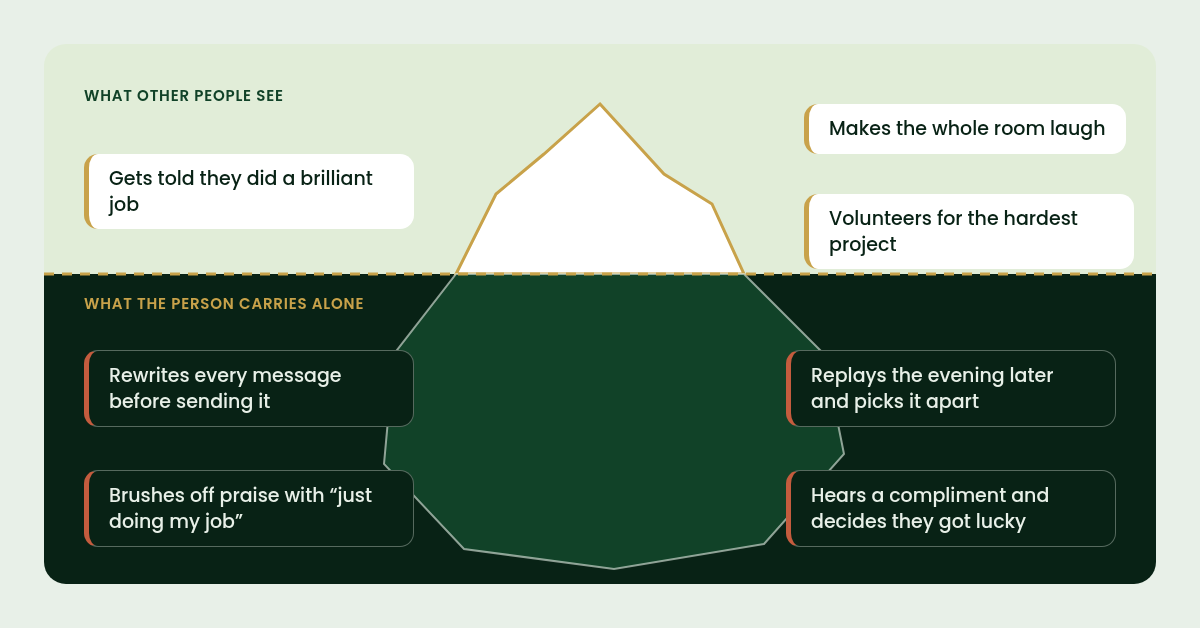
This is the combination behind a lot of high-functioning anxiety, long-running imposter syndrome, and the late-thirties or early-forties feeling of having hit your goals and feeling oddly flat about it.
The confidence is real and earned. The self-esteem floor under it is cracked, often from childhood patterns the adult success was quietly trying to make up for.
People here often pour energy into outward signs of worth, from career wins to a carefully put-together personal style that a style coach can help sharpen but which on its own will never fill the gap that created the need for it.
Many of the same people work hard on their image, their wardrobe, their presentation, hoping that getting the outside right will finally produce the ease it was never going to produce.
Work on the outside can genuinely lift confidence in social and work settings, but it sits on the confidence layer, not the self-esteem one. The self-esteem layer needs different work.
Working on this combination means going under the confidence to deal with the self-esteem directly. More skill does not help. The person already has plenty.
What is missing is the permission to feel that their competence is actually theirs, rather than a disguise about to slip.
This is where therapy often does more than coaching, though a good identity-focused coach can make real progress when the floor is not too far gone.
The stacked state. The person feels both unworthy and incapable, and the two feed each other.
Low self-esteem makes any attempt at building confidence feel pointless, since nothing they achieve would change the sense of being worthless. Low confidence then hands the inner critic fresh proof that the low self-esteem was right all along.
This one almost always does better when self-esteem comes first, often with a therapist, because building skill on top of severe low self-esteem tends to create people who are competent and still feel like nothing.
Once the floor holds weight again, confidence work starts to stick. Trying to do both at once usually means doing neither well.
| Combination | How it feels | Best first step |
|---|---|---|
| High esteem + High confidence | Grounded, secure, bounces back from setbacks | Maintain and refine |
| High esteem + Low confidence | Worthy but new to an area, normal beginner nerves | Skill-based coaching in that area |
| Low esteem + High confidence | Capable on the outside, fraud on the inside | Identity work, often therapy first |
| Low esteem + Low confidence | Both unworthy and incapable, each feeding the other | Self-esteem first (therapy), then confidence |
The cost of mixing these two up is real and easy to measure. People spend years working on the wrong level, get little back, and decide personal development does not work for them.
What actually happened is that they used a confidence fix on a self-esteem problem, or a self-esteem fix on a confidence problem, and the wrong tool was never going to do the job no matter how well they used it.
Here is what that looks like. A person with low self-esteem reads a popular confidence book and does what it says. They take more action, push past their comfort zone, get a new job, ask people out, give more talks.
Their confidence in those areas genuinely grows. They get more capable. And they still feel like they are not enough, because confidence work never touches worth, only ability.
They become a more capable version of someone who quietly hates themselves.
The opposite failure is just as common. A person with solid self-esteem but low confidence in one area, like public speaking or dating, gets pushed into identity work, affirmations, values journals, inner-child meditations.
None of it builds the skill they came for, because their identity was fine to start with. Six months later they still cannot do the specific thing they wanted to do.
The right move was twelve weeks of focused practice in that area. The wrong one cost half a year.
The Wrong-Tool Test (Use This Before Spending Money)
Ask which sentence is more true for you.
Once you can name which problem you have, the right move is obvious. The wrong one only looks appealing while the difference stays blurry.
That is why most generic personal growth content fails. It refuses to draw the line, treats the two as the same, and ends up handing out one-size advice that sometimes lands on the right level and often does not.
If confidence is your real problem, the work is concrete and the timeline is reasonable. You build it by piling up evidence in the exact area where the gap is.
Five tactics do most of the job, and they all come down to the same thing: enough good or useful attempts in the target area that your brain has to update what it thinks you can do.
Start with doable challenges in the area where confidence is low. Write them down where you will see them. Recording your wins is not vanity, it is keeping score.
The brain leans negative and will weigh one failure more heavily than several wins unless the wins are written down in front of you. A simple log of what you tried and what happened stops the brain quietly deleting the good results.
Over a few weeks the log becomes evidence. Over a few months it becomes a track record.
The shift from feeling like you cannot to feeling like you can usually lands around the point where there are too many entries to argue with. None of this is magic. It is just keeping score where you can see it.
Where you see results quickly, like getting your wardrobe and presentation in order, the log fills up fast and the change in confidence shows sooner.
Where results come slowly, like building a new skill at work, the log matters even more, because otherwise you have no way to keep score at all.
When you lack confidence, the urge is often to skip the small steps and take on the hardest version straight away, as if forcing yourself through the worst of it will break the fear for good.
It usually does the opposite. Failing badly at something too big too soon tends to deepen the avoidance rather than end it.
Progressive exposure means starting a little past your comfort zone, getting through it, and then raising the difficulty a step at a time.
For public speaking, that might be a thirty-second voice note to a friend, then a phone call, then a small group, then a presentation. For dating, a short message before a long one, a coffee before a dinner.
Each step teaches the brain that the world did not end, and that is what makes the next step possible.
The size of each step matters more than people think. Too small and the brain shrugs off the win. Too big and the failure becomes a setback instead of useful information.
The right step is one where you can picture succeeding but are not sure you will. Sit in that zone, again and again, in the exact area where the gap is, and the brain updates what you can do without you having to force it.
In any area where confidence is low, the answer is almost always more skill, not more affirmations.
If you lack confidence in dating, the answer is a better handle on conversation, a clearer read of attraction, and the honesty to say what you want.
Your brain will not accept I am confident in dating as true until it has real experience behind it, and that only comes from doing it, on purpose, again and again.
Working with a dating coach turns months of trial and error into focused practice that actually gets somewhere, because each attempt gets watched, talked through, and adjusted instead of just repeated.
The same holds for every other area where confidence is low. Skill creates confidence. Confidence does not create skill.
That is the order that matters, and the order most advice gets backward. Telling someone to be more confident in an area where they have no skill is telling them to believe something untrue.
Help them build the skill, and the confidence shows up on its own, because by then they actually can do the thing.
Confidence built entirely on your own often falls apart the first time it meets real conditions, because the picture in your head does not match what others see.
Someone who has only practiced in their own mind can talk themselves into being excellent and then find out otherwise the moment other people are involved. The fix is honest feedback from someone you trust, early and often, while you are still building.
That does not mean your most encouraging friend. It means someone who will tell you the truth even when it stings.
The brain tunes confidence to whatever information it gets. If the information is honest, the confidence holds up. If it is only what you tell yourself, it is fragile.
Keep a running record of times you handled something hard well. Specific moments, not general affirmations.
The exact difficult conversation you got through. The talk you were sure you would bomb that went fine. The first date that was awkward but ended well.
For the things that come up again and again, like knowing how to start a conversation from a cold start, this is where the handful of openers that have actually worked for you live, ready for the next time you freeze.
When the doubt hits before the next similar moment, you go back to the record. It sounds simple.
It is also one of the highest-return habits in confidence work, because it fights the brain's habit of remembering recent failures and forgetting a long history of doing fine.
Confidence is not a feeling you summon. It is a memory you can reach for.
Self-esteem responds to a different set of things, because it works at a different level.
The tactics here are slower, deeper, and harder to measure than confidence work, but they go after what is actually driving low self-esteem. Five of them form the base of any serious repair.
Most people with low self-esteem run an inner commentary they would never accept from another person. The voice calls them stupid, lazy, unworthy, embarrassing.
It does it all day, often in words so familiar they no longer register as criticism. The first step is to start catching what that voice actually says, in its exact words, several times a day.
Once you can write down what the critic says, you can ask the question that matters. Would you say this to someone you cared about? Almost always the answer is no.
The gap between how you talk to yourself and how you would talk to a friend in the same spot is the size of the problem. Closing that gap, slowly and on purpose over months, is what repairing self-esteem really comes down to.
Self-esteem rises when your daily behaviour matches what you actually value, and drops when there is a steady gap. There is nothing moral about this.
The part of your mind that judges your worth watches closely whether you act in line with what you say matters to you.
When you do, it grades you kindly. When you do not, it grades you harshly, no matter what you have achieved on the outside.
The work is to get clear on your real values, not the ones you inherited or the ones that sound good, and then find the biggest gaps between them and how you actually spend your days.
Closing one or two of those gaps moves self-esteem more than any amount of self-talk on its own. Acting in line with what you value is the most reliable signal you can send yourself about your worth.
Self-esteem is built and kept through small repeated choices that show self-respect. Saying no to things that cross your boundaries. Leaving situations that shrink you. Speaking up when something matters.
Each of those, made when it would be easier not to, counts as proof that you treat yourself like someone who deserves respect. Over months and years, that proof adds up to a steady sense of being worthy that no amount of positive thinking can fake.
The flip side is that letting your own values and boundaries get crossed, over and over, damages self-esteem no matter what story you tell yourself about why.
The mind keeps score. Self-respecting choices are the deposits. Tolerated crossings are the withdrawals. Healthy self-esteem is the long-run balance.
Who you spend regular time with shapes self-esteem more than most people realize. Relationships where you feel seen, valued, and respected hold up a healthy view of yourself.
Relationships where you feel put down, picked at, or never quite good enough wear it away, often without you noticing. The wearing-away is slow, and the person on the receiving end usually explains it away for years before they spot the pattern.
The hardest part of repairing self-esteem is usually this audit, because the relationships that damage it are often the ones that feel most necessary to keep, and the conversation that would reset things is often the one people most avoid.
Working with a communication coach on the practical side of hard conversations is one of the most useful things anyone repairing self-esteem can do, because the nerve to have the conversation usually does not show up until you have the words for it ready.
Repairing self-esteem almost always means some change in your close relationships.
That might be putting distance between you and people who consistently make you feel smaller, getting closer to the ones who do not, or having the clearing-the-air conversation that changes a relationship you want to keep.
Who is in your inner circle is one of the biggest things setting your self-esteem floor over time.
For people whose low self-esteem traces back to childhood neglect, criticism, or instability, the work that actually lasts usually means therapy rather than coaching.
The reason is practical, not a matter of willpower. Those patterns were set early, sit below conscious thought, and need clinical help to reach and change.
Coaching can do real work on the adult layer above them, but it cannot get to the wound itself. This is one of the clearest cases where matching the help to the real level of the problem saves people a lot of time, money, and effort.
If both self-esteem and self-confidence need work, the order matters.
Get it wrong and you tend to grind for little progress, because the two interact and one holds up the other. The framework below settles the order for most cases.
Decision Framework: Which to Build First
There is one exception to doing self-esteem first when both are low. If the low self-esteem is mild and the low confidence is severe and blocking something urgent, like an interview next month, the right call is sometimes short-term confidence work to clear the immediate hurdle, then longer self-esteem work once the pressure is off.
That is a judgment call based on what is at stake.
For most people, both will need attention eventually, just not at the same time.
Doing them one after the other works better than both at once, because each one needs steady attention to shift, and split attention is the enemy of either.
The order question also runs into whether the work belongs in coaching or therapy, since the two handle different levels of the problem, and the difference between what a life coach actually does and what a therapist does is the most useful thing to understand before you commit time or money to either.
Some cases of low self-esteem or low confidence sit lower than coaching or self-help can reach.
Lasting hopelessness, long stretches of feeling numb, or a sense of worthlessness that will not shift no matter the evidence are signs that what looks like a self-esteem issue may be the surface of depression, trauma, or another condition that needs clinical care.
When those signs are there, the right first step is a licensed therapist, not a coach, not a workshop, not another book.
That is not a failure of personal development. It is noticing that the problem sits deeper than personal development is built to reach.
Therapy and coaching work well one after the other, and sometimes together, but the order matters. Building skill on top of an untreated condition tends to make someone more capable without making them feel any better.
Steadying the clinical layer first lets everything else actually land.
The sooner you spot that the floor needs clinical help, the less time you waste trying to fix it from the wrong angle.
Anyone who has spent years trying to coach their way out of what turned out to be depression or a trauma response knows the cost of missing this earlier.
There is no shame in needing that layer addressed. There is a real cost to putting it off longer than you have to.
For confidence-shaped problems, the right confidence coach can move you faster than working alone, because they have watched hundreds of people go through the same thing and can turn months of trial and error into focused practice that actually shifts the belief underneath.
The work tends to follow the same shape across confidence areas. A good coach starts by pinning down which area the gap is in. Dating. Professional presence. Social settings. Hard conversations. Public speaking. Style and self-presentation.
The mapping matters, because confidence is specific to an area, and a generic fix aimed at a specific gap moves slower than a targeted one. The first sessions are about figuring out the problem, not pep talks.
From there it is design and practice. The coach builds exposure exercises and skill drills set to where the client actually is, not where they wish they were.
Then they hold the client to running those between sessions and bring the results back to look at. The structure is what speeds things up.
You can do this alone. Doing it with someone holding you to it is faster, and the gains stick better, because the wins get noticed and talked through instead of quietly forgotten.
Confidence coaching is not therapy and does not pretend to be. It does not touch the self-esteem level underneath.
For clients whose confidence issue is really a self-esteem issue in disguise, an honest coach names that early and refers them on. For clients whose issue is a genuine skill gap in a specific area, the right coach can produce visible change inside a single quarter.
The single most useful thing you can do for your own growth is to know which of these two is your real problem.
Self-esteem is your view of your worth as a person. Self-confidence is your belief in your ability to do specific things.
They are built, broken, and repaired in different ways. Working on the wrong one is the most common reason people feel stuck after years of effort.
If your self-esteem is reasonable and you just need skill in a specific area, the work is concrete and the timeline is short. Practice, exposure, evidence, and honest feedback in that one area. Eight to twelve weeks of focused effort usually produces lasting change.
If your self-esteem is low, the work is slower, deeper, and more about identity. Self-talk, values, self-respecting choices, the people you keep close, and often a therapist when the wounds underneath run deep.
Most people sit in one of the four combinations, and the way forward changes a lot depending on which. High self-esteem with low confidence in one area is the easiest to fix.
High confidence with low self-esteem is the hardest, because the outside evidence keeps saying things are fine when they are not. Low on both is the longest road and almost always starts with self-esteem.
The self esteem vs self confidence difference is not a word game. It is the difference between fixing your real problem and spending years working on one you do not have.
Once you can name which of the two you are actually dealing with, the rest of the path gets a lot clearer.
Short answers to the questions people ask most about the self esteem vs self confidence difference, with the full detail in the sections above.
Self-esteem is your view of your worth as a person, and it stays fairly steady across situations. Self-confidence is your belief that you can do a specific thing, and it changes from one area to another. One answers am I worthy, the other answers can I do this.
Yes, and it is common. Plenty of capable, accomplished people perform well and still privately feel like a fraud. The confidence is real and earned, while the self-esteem underneath it stays shaky, which is why outside success on its own rarely fixes the feeling.
If your self-esteem is reasonable and only a specific skill is missing, build confidence first, since it moves faster. If your self-esteem is low, start there, because confidence built on a weak floor tends to collapse the first time it meets real failure.
In one area, with focused practice and exposure, eight to twelve weeks usually brings visible, lasting change. Self-esteem takes longer, because it sits deeper and responds to slower, identity-level work.
It depends on the level. A confidence gap in a specific skill responds well to coaching. Low self-esteem that traces back to childhood, or that comes with lasting hopelessness or numbness, usually needs a licensed therapist, and that work should come first.
No. Self-worth is the plain fact that you have value as a person, which you cannot really lose. Self-esteem is your own read on that worth, which can drift far from the truth. The work is fixing the read, not building worth from nothing.