

Contact us
Most men know exactly what they want to say. The problem is the moment arrives and nothing comes out. This guide breaks down 15 practical techniques for starting conversations with anyone.
The simplest way to start a conversation with a stranger is to comment on something both people can see or share, such as the line they are standing in or the event they are attending, and then ask a short question about it. A shared detail gives the other person an easy reply, and that reply gives the conversation somewhere to go.
Most people expect these moments to feel more awkward than they do. Research on commuters and first meetings shows that strangers are usually happy to talk and tend to like the person who spoke first. The sections below explain how to open, what to say in common settings and how to keep the conversation going.
In most situations, the setting itself provides the first line. The table below pairs six common places with an opener that suits each one and the reason it usually works.
| Setting | Easy Opener | Why It Works |
|---|---|---|
| Coffee shop line | "Is the oat latte here any good?" | It asks for a quick opinion that anyone in line can give. |
| Work event | "Which teams are people from at this table?" | It invites introductions without singling out one person. |
| Gym | "Is anyone using this bench right now?" | It is an ordinary question that often leads to small talk. |
| Class or workshop | "Did the last part make sense to anyone else?" | Both people have just heard the same material. |
| Travel | "Is this the right gate for the Denver flight?" | People like to help, and the answer leads to where each person is going. |
| Party | "How did everyone here meet the host?" | Every guest has a story about how they know the host. |
Before they say hello, many people imagine how the moment could go wrong, from a short answer to an uncomfortable silence. This worry feels convincing, but studies show that it is usually far more negative than what actually happens.
In a 2014 study titled Mistakenly Seeking Solitude, Nicholas Epley and Juliana Schroeder asked commuters on Chicago trains and buses to start a conversation with the person sitting next to them. Before the ride, most participants expected the experience to be unpleasant and assumed that other passengers would not want to talk. Afterward, the people who talked reported a more pleasant trip than those who sat in silence, and the strangers they approached were open to chatting.
A second group of researchers studied what happened after two strangers met for the first time. They asked each person how much they thought their partner liked them, and most people guessed lower than the truth. Their partners liked them more and enjoyed the conversation more than they realized, a pattern the researchers called the liking gap. Erica Boothby and her colleagues published these findings in 2018.
This finding matters because many people replay a conversation on the way home and judge every word. Since that replay is usually harsher than the other person's view, it is rarely a fair guide to how the conversation went.
How to stop overthinking offers practical ways to quiet that kind of replay after a social moment.
A later paper by Gillian Sandstrom and Erica Boothby, titled Why Do People Avoid Talking to Strangers, looked at the reasons people hold back from these conversations. Participants said they worried about how to begin and how to keep the conversation going, and many also feared rejection. When they spoke to strangers anyway, the conversations went better than they had expected.
Not every attempt goes well, because some people are busy or simply prefer quiet. Even so, a short and friendly opener carries much less risk than it seems to in the moment, and knowing this makes it easier to speak up.
Most good openers follow the same three steps, and they are easy to remember even when nerves are high.
A bookshop offers a good example. A shopper sees someone holding a novel that they finished last month and asks whether it is the author's new book. The other person says that it is and that a friend recommended it, so the first shopper mentions that they enjoyed it and stayed up late to finish it. With that short exchange, both people have a topic they can talk about.
A good conversation moves back and forth between asking and sharing. Several questions in a row can make the other person feel interviewed, while a long story without a question leaves them with nothing to add. When each person takes a turn, the conversation feels relaxed for both of them.
The way a person approaches someone matters as much as the words they choose. A brief moment of eye contact and a small smile signal friendly intent before anything is said, which helps the other person relax. Standing slightly to the side feels less intense than standing directly in front of someone, and a calm, even pace of speech makes the first line easy to hear.
Timing matters as well. Someone who is waiting or looking around is usually open to a short chat, while someone on a phone call or focused on a task is better left alone.
Questions that begin with "what" or "how" tend to draw longer answers than questions that only need a yes or no. A question like "Was the talk good?" often gets a one word reply, while "What was the most useful part of the talk?" asks for an opinion that the other person can explain. A yes or no question still works as a first line, as long as an open question follows soon after.
A compliment works best when it is about something a person has chosen, such as a bag or a book. Remarks about someone's body or face tend to feel too personal coming from a stranger, so they are best avoided. The most useful compliments also lead to a story, which is why "That camera looks great. Is it hard to use?" works far better than a comment on someone's looks.
The 27 openers below are grouped by setting. They work best as starting points rather than scripts, so it helps to adjust the wording to fit the moment.
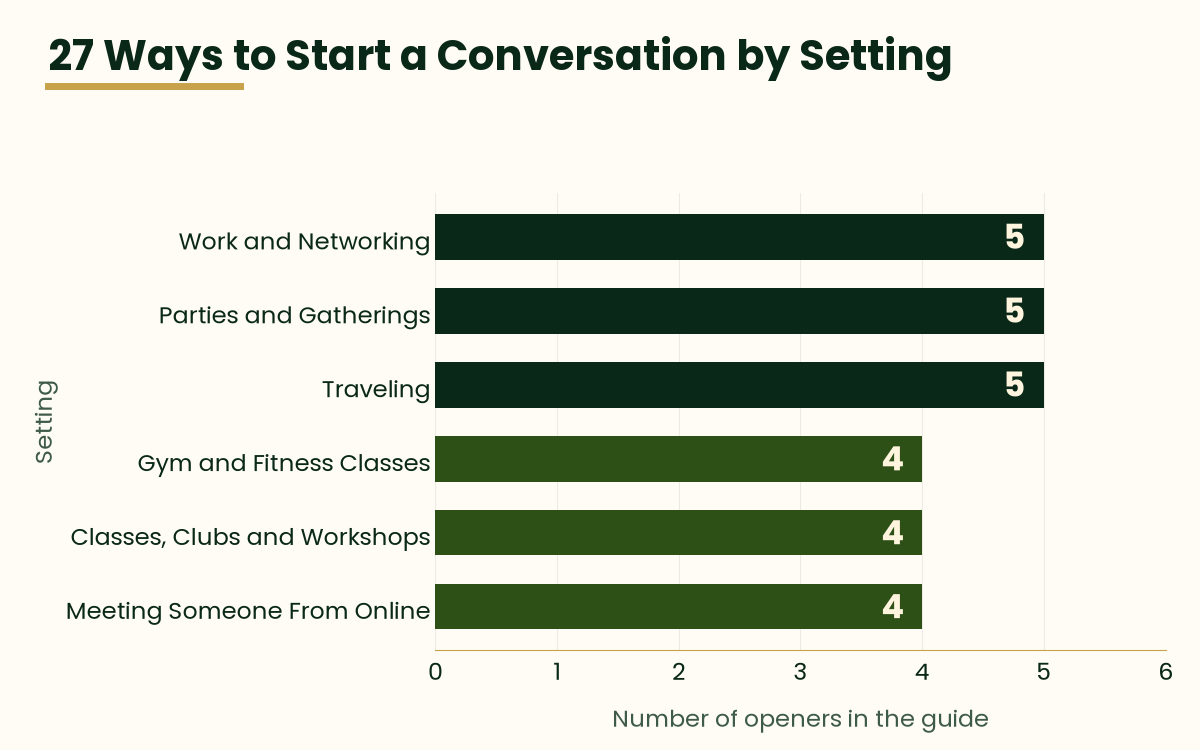 The 27 openers in this guide, sorted by the setting where a person wants to start a conversation.
Each of these lines is tied to the setting and easy to answer, which means the other person can reply briefly or carry the conversation further. That freedom to choose is what makes a good opener comfortable for both people.
The first reply to an opener is often short, and this is normal rather than a sign of disinterest. Most people need a moment to shift their attention from their own thoughts to someone new, so the conversation usually takes shape over the next few exchanges.
Most answers contain more information than they first appear to. If someone mentions that they are in town for their sister's wedding, there are natural questions about the sister and about the wedding itself. Following up on one of those details shows that the listener is paying attention, and it keeps the conversation moving more smoothly than switching to a new topic each time.
People relax when they learn a little about the person they are talking to, so it helps to offer something in return. The detail does not need to be personal or deep, because a line about where one is from or why one is there is usually enough. This small exchange gives the other person an easy way to join in.
Short pauses happen in every conversation, even between close friends, so there is no need to fill each one. A pause gives both people time to think, and it is a natural point to mention something new in the setting or return to an earlier topic. For example, someone might say, "Going back to the Lisbon trip, what was the food like?"
When the mind goes blank, the surroundings remain a reliable source of topics. A comment on the music or the food is usually enough to restart the conversation.
Some topics suit a first conversation better than others, and the best ones are light enough for both people to join without effort.
Once the conversation feels comfortable, it can move gradually toward slightly bigger topics. A question about weekend plans might lead to a favorite hobby, and a chat about a city might lead to why someone moved there. This works best when each step is small and follows the other person's level of interest.
Reading the other person's signals removes much of the guesswork, because most people show fairly clearly whether they want to continue.
Someone who is enjoying the conversation usually gives longer answers and asks questions in return. They often turn their body toward the speaker and add stories of their own, which is a clear sign that it is fine to keep talking.
Someone who would prefer to stop tends to give very short answers and may look at their phone or around the room. Headphones and an open book usually mean that a person wants quiet. These signals rarely have anything to do with the speaker, since people are often tired or simply not in the mood to chat.
When the signals are mixed, one more open question usually makes the situation clear. If the answer is still short, the polite choice is to end the conversation kindly.
Many people stay in a conversation longer than they want to because they are unsure how to leave. A good exit is short and friendly, and it leaves both people with a positive memory of the exchange.
People tend to remember the end of a conversation more clearly than the middle, so a warm goodbye matters. It also makes it easier to say hello the next time the two people meet.
Many first meetings now begin with messages, which can make the first face to face moment feel a little strange. Both people already know something about each other, yet they are still strangers in person.
The easiest approach is to build on what has already been shared, because a topic from the messages gives both people a familiar starting point. Asking how the trip to the venue went also helps ease the first few minutes. It is worth keeping expectations modest, since some people are quieter in person and need a little time to relax.
This advice applies to new friends and work contacts as well as to dates, because the first few minutes feel much the same in each case.
Starting conversations becomes easier with regular practice. The aim is not to become the most outgoing person in every room but to make the first line feel ordinary instead of stressful.
Brief exchanges with a barista or a neighbor are a good place to begin, because they are short and have a natural ending. After a few weeks of these small conversations, longer talks with new people start to feel more familiar.
A clear goal makes practice easier to keep up. Some people aim for one new conversation each day, while others choose three each week. Writing a short note about how each conversation went often shows that most of them were pleasant, and that record is helpful on days when nerves feel stronger.
Nerves tend to grow when attention turns inward to how one looks or sounds. Listening closely to the other person reduces that pressure, and curiosity about them leads to better questions. A useful habit is to try to learn one new fact about each person, since that small task leaves less room for worry.
For some people, the fear of talking to strangers is strong enough to keep them away from events or new friendships. In that case, a doctor or therapist can check for social anxiety and suggest treatment. Other people do not have that level of fear but would like to improve faster with regular practice and honest feedback from someone experienced.
Communication coaches for everyday talks work with people on that kind of practice, using situations from their own lives.
Starting a conversation with a stranger rarely requires a clever line. In most cases, a comment about the shared setting and a simple question are enough, especially when they are followed by a small detail in return. Research shows that strangers are usually more open than people expect and that they tend to like the person who spoke first more than that person realizes. Some conversations will be brief, and that is perfectly normal. Over time, these small exchanges build confidence and often lead to new friendships and a stronger sense of belonging.
A good first line refers to something both people share at that moment, such as the place or the wait. Questions like "Is this the line for tickets?" or "Has anyone tried the soup here?" are easy to answer and often lead to a longer conversation.
Shy people often find practical questions easier because they feel less personal. Asking for a recommendation or directions is a natural way to begin, and short chats in shops and cafés are a low pressure way to practice.
Topics such as politics and religion are best avoided in a first conversation, along with comments about someone's body. Lighter subjects such as food and travel feel safer for most people.
There is no set length, and some of the most pleasant conversations last only a minute or two. The other person's signals matter more than the clock, so if they are asking questions and giving full answers, it is fine to continue.
Headphones usually signal that a person wants quiet, so it is better to leave them alone unless there is a practical reason to speak. A dropped wallet or a quick question about the train is a fair exception, as long as the question is brief and polite.
Friendships often grow from seeing the same person repeatedly, such as at the gym or in a weekly class. After a few friendly conversations, suggesting a coffee or swapping contact details is a natural next step.