

Contact us
Overthinking is a habit of looping thoughts, and you can change it. These 12 simple steps help you quiet your mind, sleep better, and decide with less stress.
Learning how to stop overthinking starts with one idea. You cannot win against a loop by thinking harder. If you have ever lain awake at 2 a.m. replaying one awkward sentence, you know what overthinking costs. You lose sleep, focus, and confidence. Even small choices start to feel huge.
This guide gives you 12 simple steps you can use today. Some work in the moment. Others build calm over time. You will also learn how to tell normal worry from a problem that needs a doctor or therapist. Pick two or three steps that fit your day, and start there.
To stop overthinking, notice the loop and name it. Then give the thought a clear limit, such as ten minutes of planned thinking. Write down what you can control, pick one small next step, and move your body or switch tasks. Repeat this daily. If racing thoughts hurt your sleep or daily life, talk to a doctor or therapist.
Key Takeaways
- Overthinking means going over the same thoughts again and again without reaching an answer.
- Pushing thoughts away often makes them come back. Planned thinking time works better.
- Writing things down, making a small plan, and taking one action all break the loop.
- Slow breathing, a short walk, or a change of scene helps in the moment.
- If overthinking lasts for weeks or harms your sleep, work, or relationships, see a doctor or therapist.
Overthinking means replaying the same thoughts without reaching an answer or taking a step. Psychologists use two words for it. Worry looks ahead at what might go wrong. It sounds like, "What if I fail the interview?" Rumination looks back at what already happened and how it made you feel. It sounds like, "Why did I say that in the last interview?" Most people do both.
Research reviews show that rumination can feed a low mood, strengthen negative thinking, and make problems harder to solve (Nolen-Hoeksema, Wisco and Lyubomirsky, 2008). Harvard Health adds that people keep going because they hope the next round of thinking will give them insight. Most of the time it does not. It only uses up time and focus.
Your mind is trying to protect you. It treats an open question like a danger and keeps checking it. The trouble is that it cannot tell a real emergency from a chat that felt awkward three days ago. Telling yourself to stop rarely works. A better plan is to guide your attention somewhere useful, and that is what every step below does. You do not need to be calm first. You only need a small, clear action to take.
Here is a quick test. Careful thinking ends with a decision or a next step. Overthinking ends with a worse mood and no new idea. If you have been on the same question for an hour and nothing has changed, you are most likely overthinking.
Overthinking often feels like preparing or being responsible. These four signs show it has gone too far.
The talk is over, but your mind is still running it an hour later. You check every line you said and every pause they made. Maybe you wonder if a joke came across wrong or if your reply sounded cold. The other person has likely forgotten most of it, while you carry it around all evening.
If this happens most in social situations, our guide on how to be more socially confident can help.
Small choices turn into long lists of what-ifs. You spend an hour on what to order or how to word a reply, while the big decisions wait. Each option seems to lead to three more problems, so you stay stuck.
You send a message and start preparing for a bad answer. You make a choice at work and imagine the failure for three days. Your mind jumps to the worst outcome and skips the likely ones.
Without tasks to focus on, every open worry shows up at once. Poor sleep then makes the next day harder, and that feeds more overthinking.
Overthinking has common triggers. Knowing yours helps you pick the right steps below.
Read all 12 first. Then choose the two or three that match your pattern and try them for a week.
The first step is to notice that you are looping. Then say it plainly, out loud or on paper. This small pause gives you a choice instead of a spiral.
Give your worries a set time instead of letting them run all day. The NHS suggests a short daily "worry time" of about 10 to 15 minutes. In a small two-week study of 53 people who worry a lot, those who kept a daily worry period reported less worry, anxiety, and insomnia than a comparison group (McGowan and Behar, 2013).
Moving breaks the loop because your mind has to follow what your body is doing. Harvard Health lists exercise among the ways to disrupt looping thoughts.
Your mind keeps returning to a thought partly because it fears you will forget it. The NHS notes that writing worries down helps people manage them. Paper can hold the thought for you.
Much overthinking is about other people's reactions, results you cannot predict, and past events. The NHS calls one version of this a "worry tree". You ask whether you can do something about the worry.
An overthinking mind treats a scary thought as a fact. Checking it is a common skill in cognitive behavioral therapy (CBT). Ask yourself three questions.
Here is an example. Say you fear your friend is angry because they have not texted back. The evidence is that they are busy on weekdays and often reply late. Another view is that they saw the message and forgot. If they were upset, you would ask them about it and listen. Once you answer all three, the fear usually shrinks. Even when something hard is possible, you often find you could cope better than fear suggested.
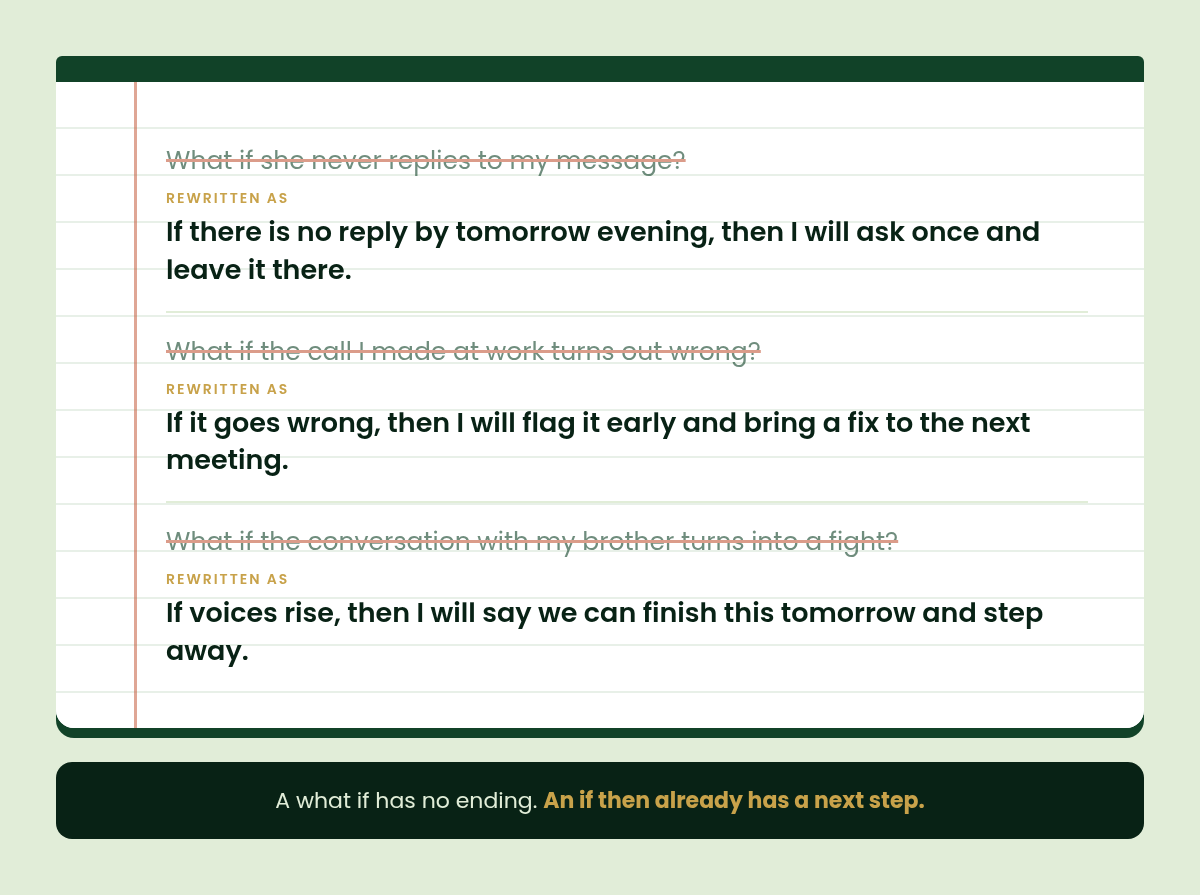
A "what if" thought leaves you with no next move. An "if then" plan gives your mind a job to do, which makes it easier to let the worry rest.
Overthinking pulls you into the past or the future. Paying close attention to the present moment gives your mind a break from both. Harvard Health lists mindfulness among tools that can stop looping thoughts.
If a need for certainty drives your thinking, finding more information will not fix it. Learning to act without full certainty will.
A confidence coach can help you build trust in your own ability to handle what comes.
Night is when thoughts get loudest. The NHS suggests keeping a regular sleep routine, relaxing before bed, and avoiding screens for an hour before sleep. It also suggests writing a to-do list for tomorrow if you worry in bed.
Relationship overthinking often means reading hidden meaning into small things, such as a short text or a quiet evening. You cannot know another person's thoughts by studying their behavior, so asking works better.
A communication coach can help you practice these talks before you have them.
Every step above works on your own. If your overthinking is long-standing or affects your work and relationships, steady support can speed things up.
A mindset coach helps you find the patterns and beliefs behind your overthinking and builds a plan around your life.
A first session often starts with simple questions. When does the overthinking show up? What do you tend to tell yourself? What have you already tried? From there, you and your coach pick one or two small habits to test.
Choosing support is a practical decision, and it does not mean you failed.
You do not need to use all 12 steps at once. This plan builds the habit slowly, and each day takes 10 minutes or less.
If a week feels too short, repeat it. Many people need a few rounds before the habits feel natural.
Sometimes the loop is already running, and you need relief fast. Try one of these.
Overthinking and negative thoughts feed each other. Overthinking gives negative thoughts room to grow, and negative thoughts give overthinking something to chew on.
Forced positive thinking rarely helps. Your mind knows when you are not convincing yourself. Realistic thinking works better. Ask three questions.
If the thought is true, act on it. For example, if you worry that a deadline is close, make a plan and start. If the thought is not true, notice it and let it pass. Try speaking to yourself the way you would speak to a friend with the same worry. Talking it over with someone you trust can also bring the thought back to size, and Harvard Health suggests this too.
Everyone overthinks sometimes. It becomes a health matter when it takes over your life. Talk to a doctor or licensed therapist if any of these are true.
The NHS says the main sign of generalized anxiety is worry that affects daily life and feels hard to control. It advises seeing a doctor if you think you may have it. Talking therapies such as CBT are well studied and often help. A doctor or therapist can also check for causes such as depression, health problems, or medicine side effects.
At a first visit, you can expect questions about your thoughts, sleep, mood, and daily life. You do not need the right words. Saying "my mind will not stop" is enough to begin. Many people feel relief just from naming the problem to someone trained to help.
If you ever have thoughts of harming yourself, get urgent help. In the United States, call or text 988. Outside the United States, call your local emergency number.
A life coach can support your goals, habits, and decisions.
A coach does not diagnose or treat mental health conditions, so coaching works best alongside medical care when you need both.
Knowing how to stop overthinking is a skill, and skills grow with practice. You will not stop every thought, and you do not need to. The goal is to catch the loop sooner and have a plan ready. Start with the steps that match your pattern, and give them a few weeks before you judge the results.
If you want a guide who can help you build those habits, you can browse Muse coaches and choose one who fits you.
And if you have done this work yourself and want to help others, you can become a Muse coach.
Overthinking often comes from a strong need for certainty, past experiences that went badly, perfectionism, or high stress. Your mind keeps checking a problem because it hopes to feel safe. Naming your main trigger helps you choose the right strategy from the list above.
It can be. Constant worry that is hard to control is the main sign of generalized anxiety disorder, according to the NHS. Many people overthink without having an anxiety disorder, though. If it happens most days and affects your life, a doctor or therapist can help you find out.
Most people notice small changes within a week or two of regular practice, such as catching a loop sooner. Lasting change usually takes several weeks. Expect good days and hard days, and judge your progress over time rather than day by day.
Thinking through a problem with a clear goal can be useful, and psychologists call this reflection. It turns into overthinking when you go in circles, feel worse, and take no action. A good test is to ask whether your thinking has produced a new idea or a next step.
Write down your worries and one next step for each, about 30 minutes before bed. Keep screens away in the last hour, and try slow breathing or muscle relaxation. If you are still awake after about 20 minutes, get up and do something quiet until you feel sleepy.
A coach can help you build habits, test unhelpful beliefs, and stay on track with daily practice. A therapist or doctor is the right choice if you have symptoms of anxiety or depression, or if your sleep and daily life are suffering. Some people use both.