

Contact us

Being more socially confident does not mean changing who you are. Simple steps help ease self doubt, handle awkward moments and speak up with ease.
Learning how to be more socially confident starts with accepting who you are, expressing yourself naturally, and becoming more comfortable around others without pretending to be someone else.
Whether you are naturally quiet, feel awkward in groups, or struggle to speak up around new people, you can build genuine social confidence through small, consistent changes. You do not need to become the loudest person in the room to feel confident.
Social confidence is also different from how a person values themselves, and the difference between self esteem and self confidence explains why both matter.
Discover practical ways to overcome self-doubt, handle awkward moments, and feel more at ease in social situations as you explore how to build confidence while staying true to yourself.
Building social confidence does not mean changing your personality or trying to impress everyone. It means learning to trust yourself, participate in conversations, and handle uncomfortable moments without judging yourself too harshly.
Here are seven simple ways to get started:
Social confidence means feeling comfortable enough to interact with people, express yourself, and participate in social situations without needing everything to go perfectly.
It does not mean you never feel nervous, always know what to say, or enjoy being around large groups. A socially confident person can feel shy before meeting someone new and still choose to participate.
Social confidence also looks different for different people. Someone who enjoys spending time alone can be just as socially confident as someone who loves parties and meeting new people.
The difference is how much freedom you feel to be yourself around others.
| Low social confidence | Genuine social confidence |
|---|---|
| Worrying about every word before speaking | Expressing thoughts without needing perfect wording |
| Agreeing with everyone to avoid rejection | Sharing honest opinions respectfully |
| Avoiding situations that might feel awkward | Trying new situations despite some nervousness |
| Replaying conversations and looking for mistakes | Learning from interactions and moving forward |
| Feeling responsible for making everyone like you | Accepting that not everyone will share the same opinion |
The goal is not to eliminate every uncomfortable feeling. It is to stop letting those feelings control how you interact with people.
Have you ever tried to act confident around people but felt uncomfortable doing it? Perhaps you forced yourself to smile, tried to sound more outgoing, or copied how someone else behaved because you thought that was what confidence looked like.
The problem is that you may have been focusing more on how you appeared than on how you actually felt.
When you feel self-conscious, you may pay too much attention to your own behavior. You might wonder whether your voice sounds strange, whether people find you interesting, or whether you look uncomfortable.
This constant self-monitoring can make ordinary interactions feel like a performance. Instead of enjoying the moment, you spend your time checking whether you are doing everything correctly.
Research supports this pattern, as an experimental study on self focused attention found that turning attention inward during conversations made people feel more anxious and appear more anxious to others.
Try shifting your attention toward the person you are speaking with, the topic being discussed, or what is happening around you. You do not need to evaluate every little thing you do.
It is natural to want others to like you. However, when getting approval becomes your main goal, you may start changing your behavior to match what you think other people want.
You might laugh at jokes you do not find funny, hide your opinions, or pretend to enjoy things that do not interest you.
Over time, this can leave you feeling disconnected from yourself. You may even wonder whether people like the real you or the version of yourself you show them.
You can be considerate without constantly trying to impress everyone. Allowing your genuine preferences and opinions to show is an important part of building social confidence.
Social media and everyday interactions can make confidence look effortless. You see people speaking comfortably, making others laugh, and appearing completely relaxed.
It is easy to assume they never feel nervous or uncertain. In reality, confident people can experience awkwardness too. They may simply be less likely to treat an uncomfortable moment as proof that something is wrong with them.
Instead of waiting until you feel completely confident, practice participating while accepting that some nervousness may remain.
Watching people who seem socially confident can give you useful ideas. However, copying their entire personality may feel unnatural.
For example, you might try to become louder, make constant jokes, or speak more than you normally would because you believe confident people behave that way.
You do not need to adopt those habits if they do not suit you. If you are naturally thoughtful and quiet, you can build confidence by expressing yourself more openly rather than trying to become the most outgoing person in the room.
Genuine confidence is not about performing a personality. It is about becoming more comfortable expressing your own.
Building social confidence becomes easier when you focus on small, realistic changes rather than trying to transform your personality. The following strategies can help you feel more comfortable while remaining yourself.
When you enter a room or meet someone new, you might feel pressure to say the right thing, make a good impression, or avoid doing anything embarrassing.
This can make a simple interaction feel much more difficult than it needs to be.
Instead of asking yourself, "Am I making a good impression?" try asking, "Can I be present in this moment?"
You do not need to be interested every second. You can listen, share a thought when you have one, and allow the interaction to develop naturally.
For example, when joining a group discussion, you do not have to come up with the perfect comment. You can contribute a simple observation or ask a relevant question when you genuinely want to.
The more you stop treating social situations as tests you must pass, the easier it becomes to participate without putting pressure on yourself.
One of the easiest ways to reduce social pressure is to become genuinely curious about other people.
Ask questions about their interests, experiences, or opinions. Listen to their answers and follow up when something catches your attention.
For example, if someone mentions that they enjoy travelling, you could ask what their favourite destination has been or what they enjoyed most about their last trip.
Readers who want simple openers and follow up questions can turn to this practical guide on how to start a conversation.
The goal is not to ask endless questions. Share your own experiences, too, so the conversation feels balanced and natural.
For example:
You may still feel nervous at first. That is okay. The aim is not to force yourself to feel relaxed but to become less preoccupied with evaluating yourself.
If you regularly hide your opinions because you are afraid of disagreement, social situations can begin to feel exhausting.
You might agree with other people automatically, avoid saying what you prefer, or keep quiet even when you have something to contribute.
You do not need to start expressing every thought you have. Instead, practice being a little more honest in everyday situations.
For example, you could say:
These small moments help you become more comfortable expressing yourself without making every interaction a major challenge.
Remember that being authentic does not mean being blunt or dismissive. You can disagree respectfully, consider other perspectives, and still stand by your own preferences.
Being agreeable can make social interactions easier in the short term. However, constantly putting other people's preferences ahead of your own can make it difficult to feel comfortable being yourself.
You might accept invitations you do not want to accept, laugh along with opinions that bother you, or avoid setting boundaries because you fear disappointing someone.
Over time, this habit can leave you feeling frustrated or unsure of what you genuinely want.
Start by noticing when you agree because you mean it and when you agree because you are afraid of someone's reaction.
If you need time to think, you can say, "Let me think about that first." If you do not want to do something, you can decline politely.
You do not have to become confrontational to build social confidence. You simply need to give your own feelings and preferences the same consideration you give to other people's.
One of the biggest obstacles to social confidence is the belief that you must avoid awkwardness at all costs.
You might worry about a conversation becoming quiet, making a mistake while speaking, or saying something that does not get the response you expected.
When you treat every awkward moment as a problem that needs fixing, you may become even more nervous about future interactions.
Instead, try allowing small moments of discomfort to pass without immediately correcting them.
If there is a pause, you do not always need to fill it. If you stumble over your words, you can continue without apologizing repeatedly. If someone does not respond as warmly as you expected, you do not need to assume you have done something wrong.
Not every interaction will feel smooth, and that is a normal part of spending time with other people. Learning to tolerate these moments helps you understand that you can handle social discomfort without losing your confidence.
You do not have to start by attending a large event or forcing yourself to speak in front of a group.
Building confidence through smaller experiences can make the process feel more manageable.
Choose situations that challenge you slightly without overwhelming you. If you usually stay quiet in group discussions, try contributing one thought. If meeting new people feels difficult, begin by interacting with someone in a familiar setting.
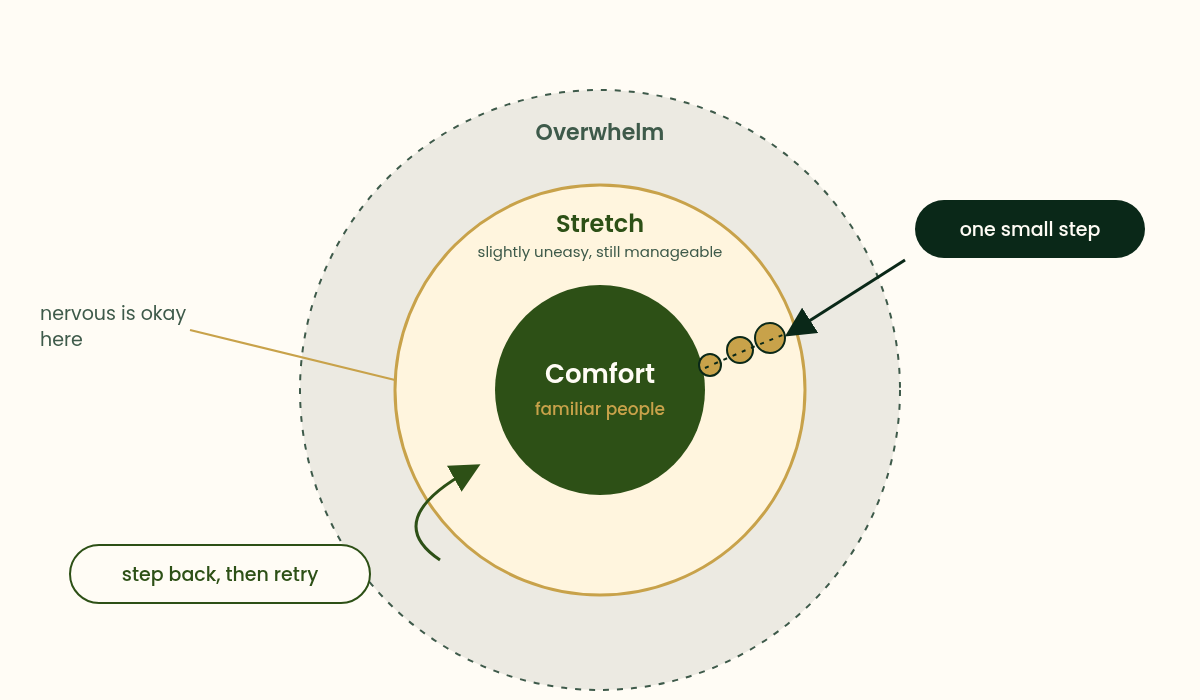
You could gradually practice:
Focus on what you are willing to try rather than whether you feel completely confident while doing it.
If you experience significant anxiety, move at a manageable pace rather than pushing yourself into situations that feel overwhelming. When social fear substantially affects your everyday life, professional mental health support may be helpful.
Sometimes, the interaction itself is not the most difficult part. It is what happens afterward.
You might spend hours wondering whether your comment sounded strange, whether someone misunderstood you, or whether you should have behaved differently.
This habit, often called post-event rumination, can make an ordinary interaction feel like a failure even when there is little evidence that anything went wrong.
Research backs this up, as a systematic review of post event rumination found a moderate link between replaying social moments and symptoms of social anxiety.
Instead of analyzing every detail, give yourself a simple way to reflect.
Ask yourself:
Then let the experience end.
You do not need to convince yourself that every interaction was perfect. You simply need to recognize that one imperfect moment does not define your social abilities.
It is easier to feel authentic when your behavior reflects what matters to you.
If you value kindness, you can show interest in others without trying to impress them. If you value honesty, you can express your opinions respectfully. If you value meaningful relationships, you can focus on genuine connections instead of trying to be popular.
Think about the qualities you want to bring into social situations.
Perhaps you want to be a good listener, someone who speaks honestly, or someone who makes others feel welcome. These qualities provide a more stable foundation for confidence than trying to control whether everyone likes you.
You cannot control every person's opinion of you. You can, however, make choices that reflect the kind of person you want to be.
You do not need to change everything at once. Start with a few manageable actions and gradually build on them.
| When | What to practice | Why it helps |
|---|---|---|
| Before a social situation | Remind yourself that you do not need to impress everyone | Reduces unnecessary pressure |
| During an interaction | Pay attention to the other person instead of monitoring yourself constantly | Helps you stay engaged |
| When sharing an opinion | Express one genuine preference or thought | Builds comfort with self-expression |
| When something feels awkward | Allow the moment to pass without overcorrecting | Helps you tolerate uncertainty |
| After the interaction | Identify one thing you learned and move on | Reduces excessive rumination |
You can repeat this process in everyday situations. The goal is not to measure every interaction or turn social confidence into another task you must perform perfectly.
Instead, use these small practices to become more comfortable participating in your own way.
Social confidence does not always mean feeling less nervous. Sometimes, the biggest improvement is that nervousness no longer determines what you do.
You might notice that you speak up even when you are unsure, share your preferences more comfortably, or recover from an awkward moment without thinking about it for the rest of the day.
Other signs include feeling less responsible for keeping every interaction interesting, becoming more comfortable with disagreement, and spending less time worrying about whether everyone approves of you.
These changes may happen gradually. Some situations will feel easier than others, and you may still experience periods of self-doubt.
That does not mean you are going backward. Confidence develops through experience, and progress is rarely perfectly consistent.
Feeling shy or self-conscious from time to time is common. However, if fear of judgment causes you to avoid everyday activities, affects your relationships, or makes work and social situations consistently difficult, it may be more than ordinary nervousness.
Social anxiety can involve intense fear of being judged, embarrassment, or scrutiny by others. A qualified mental health professional can help you understand these experiences and explore appropriate treatment options.
Coaching may also be useful if you want structured support with personal goals, assertiveness, communication, or practicing new behaviors. A coach can help you identify patterns and work toward specific changes, although coaching is not a substitute for mental health treatment when a clinical condition requires care.
If you would like personalized guidance, exploring a confidence coach may help you identify practical ways to build confidence that suit your personality and goals.
Learning how to be more socially confident does not require you to become louder, more entertaining, or more outgoing. It begins with allowing yourself to participate without constantly judging your performance.
When you express your opinions honestly, accept awkward moments, and stop trying to earn everyone's approval, social interactions can gradually feel more natural.
You will not feel confident in every situation, and you do not need to. Give yourself room to learn, make mistakes, and discover what works for you.
Genuine social confidence is not about pretending to be someone else. It is about feeling more comfortable being yourself around other people.
Practice expressing your opinions, participating in conversations, and accepting small awkward moments. Focus on gradual progress rather than trying to change your personality.
Yes. Introverts can be socially confident without enjoying large groups. Confidence means feeling comfortable expressing yourself, regardless of your personality.
You may be copying others or trying too hard to impress people. Focus on small, genuine actions that reflect your personality and values.
Remember that you cannot control everyone's opinions. Focus on your actions and values instead of constantly seeking approval.
Allow yourself to make mistakes, experience pauses, and feel nervous sometimes. The more you accept these moments, the less pressure you may feel to avoid them.
Some people feel naturally comfortable in social situations, while others develop confidence through practice, experience, and learning to manage self-doubt.
Start by sharing small opinions with people you trust. Gradually practice speaking in more challenging situations without waiting to feel completely confident.
Shift your attention toward the present interaction instead of monitoring yourself. Afterward, focus on one lesson rather than replaying every detail.
There is no fixed timeline. Progress depends on your experiences, challenges, and consistency in practicing new behaviors.
A confidence coach can help you identify unhelpful patterns, set practical goals, and practice expressing yourself more comfortably. For persistent or severe social anxiety, a qualified mental health professional may be more appropriate.