

Contact us
A clear guide to what a life coach is, what happens in a coaching session, the areas coaching can help with, and how life coaching differs from therapy.
Life can feel confusing when you know something needs to change but are unsure where to begin. You might be struggling to make an important decision, feeling stuck in familiar habits, or finding it difficult to turn your goals into consistent action. Even when you understand what you want, figuring out how to move forward can be challenging.
This is where life coaching can help. A life coach works with you to clarify your priorities, explore the challenges holding you back, and develop practical steps toward meaningful goals. Rather than simply telling you what to do, a coach helps you examine your options and make decisions that align with your values and aspirations.
But what is a life coach, what does a life coach do during a typical session, and how does life coaching work in practice?
Understanding the process can help you decide whether coaching is the right approach for your personal or professional goals.
This guide explains what to expect, the areas where coaching may help, and how it differs from other forms of support.
If you decide that coaching aligns with your needs, you can explore available life coaches to learn more about your options.
Life coaching helps people clarify their goals, work through challenges, and take practical steps toward personal or professional growth. A life coach uses guided conversations, goal-setting, and accountability to help clients explore their options, make informed decisions, and work toward meaningful changes. Coaching can support areas such as self-confidence, career direction, healthy habits, and work-life balance, but it does not replace mental health treatment.
A life coach is a professional who helps people clarify their goals, identify obstacles, and take practical steps toward personal or professional growth. Life coaching provides a structured space to reflect on your current situation, explore different possibilities, and decide what changes you want to make.
Unlike a friend who may share advice based on personal experience, a life coach uses active listening, thoughtful questions, goal-setting, and accountability to help you explore solutions that fit your circumstances. The aim is to help you recognise your strengths, evaluate your options, and make decisions that align with your priorities.
Imagine feeling dissatisfied with your daily routine but being unsure what needs to change. A life coach can help you explore which areas of your life feel unfulfilling, identify what matters most to you, and determine practical steps toward a more satisfying routine. Rather than making decisions for you, the coach supports you in developing your own understanding and action plan.
Life coaching can address a range of goals, including improving self-confidence, making career decisions, developing healthier habits, strengthening communication, and creating a better work-life balance. The focus depends on your individual needs, priorities, and desired outcomes.
The coaching profession has also grown worldwide. According to the International Coaching Federation's 2025 Global Coaching Study, the estimated number of coach practitioners worldwide reached 122,974, a 15% increase since 2023. These figures cover the broader coaching profession, not life coaches alone.
See the ICF Global Coaching Study for the full findings.
It is equally important to understand the limitations of life coaching. A life coach does not make decisions on your behalf or guarantee specific results. Progress depends partly on your participation and willingness to apply what you learn. Life coaching is also different from psychotherapy and medical treatment, and it should not replace professional mental health care when that support is needed.
A life coach helps you turn personal goals into practical actions by providing structure, asking thoughtful questions, and helping you recognise patterns that may be preventing progress. Rather than offering a solution for every problem, a coach works with you to understand your situation, explore possible approaches, and choose realistic next steps.
The exact responsibilities depend on your goals, but life coaching often involves the following activities.
Sometimes, the biggest challenge is not a lack of ambition but uncertainty about what you actually want. You might feel dissatisfied with your career, personal relationships, or daily routine without knowing which area deserves your attention first.
A life coach helps you explore your priorities, identify what matters most, and distinguish your own goals from expectations placed on you by others. This process can make it easier to decide where to direct your time and energy.
For example, if you feel unhappy with your professional life, a coach might help you determine whether you need a different role, better work-life balance, or a clearer sense of purpose.
Repeated habits and thought patterns can make it difficult to move forward, even when you understand what needs to change. Procrastination, fear of failure, perfectionism, and difficulty setting boundaries may interfere with your progress.
A life coach helps you examine these patterns and consider how they influence your decisions. Through guided questions and reflection, you can identify situations in which you tend to get stuck and explore more constructive ways to respond.
Coaching does not mean every obstacle will disappear. It helps you recognise what you can change and develop strategies for handling challenges more effectively.
Having a goal is only the beginning. Progress often requires breaking a larger objective into manageable steps that fit your circumstances.
A life coach can help you establish realistic milestones, identify the resources you need, and decide which actions to take first. For instance, someone who wants to build a healthier routine might begin by setting a consistent bedtime, scheduling regular exercise, and reviewing their progress each week.
These smaller commitments make it easier to track progress and adjust the plan when circumstances change.
It is common to start working toward a goal with enthusiasm and then lose momentum when everyday responsibilities take over. Regular coaching sessions provide an opportunity to review commitments, discuss difficulties, and identify what needs to change.
A coach may ask what you accomplished since your last session, what prevented you from completing a task, and what you will do differently next time. This creates a structured process for following through on your decisions.
Accountability is not about being judged or pressured. It is about taking responsibility for your choices and learning from your experiences.
Life coaching also creates space to examine your decisions, values, strengths, and expectations. You may discover that a goal no longer reflects what you want or that a different approach would better suit your circumstances.
For example, someone who believes they must always say yes to others might explore how this habit affects their time, energy, and relationships. With a coach's support, they can practise setting clearer boundaries and making decisions that better reflect their priorities.
The purpose is to help you become more intentional about your choices rather than relying on the same responses out of habit.
Overall, what a life coach does is help you move from uncertainty to informed action. The coach provides guidance, structure, and accountability, while you remain responsible for your decisions and the steps you take toward your goals.
If you are exploring life coaching as a profession, understanding the coaching process is only one part of building a practice. Reaching people who need your support is another important consideration.
This guide on how to get coaching clients covers different ways coaches can connect with potential clients and grow their practice.
Life coaching works through a structured, collaborative process in which you identify what you want to change, explore the challenges preventing progress, and develop practical steps toward your goals. Sessions provide an opportunity to reflect on your situation, consider different perspectives, and review the actions you take between meetings.
Although every coach has a slightly different approach, the process generally follows several stages.
The process usually begins with a conversation about your current situation and what you hope to achieve. You might want to improve your confidence, make an important career decision, develop healthier habits, or create a better balance between work and personal life.
Your coach helps you explore why these goals matter and what you would like your life to look like. This discussion establishes a starting point and helps you focus on the areas that deserve the most attention.
For example, if you feel dissatisfied with your career, the initial conversation might reveal that the main issue is not your job itself but a lack of flexibility or opportunities for growth.
Once you have identified your priorities, you and your coach explore the obstacles that may be making progress difficult. These could include unhelpful routines, competing responsibilities, uncertainty, or assumptions that influence your decisions.
A coach may ask questions such as, "What has stopped you from taking this step before?" or "What options have you not considered yet?" These questions encourage you to examine your situation from different perspectives.
The aim is not to criticise your past decisions. It is to understand what has been happening so you can make more informed choices moving forward.
Broad intentions can be difficult to act on. Saying you want to become more confident or improve your work-life balance does not necessarily tell you what to do next.
A life coach helps you turn these intentions into specific, achievable goals. You might decide to speak up in one meeting each week, set a boundary around your working hours, or dedicate time every Sunday to planning the week ahead.
Clear goals give you something concrete to work toward and make it easier to recognise progress.
After establishing your goals, you and your coach identify the actions needed to achieve them. This may involve breaking a larger objective into smaller tasks, setting deadlines, identifying possible obstacles, and deciding how you will respond when difficulties arise.
Suppose you want to make more time for personal interests but regularly allow work to take over your evenings. Your action plan might involve setting a finishing time, scheduling one personal activity during the week, and reviewing whether the arrangement is realistic.
The plan should fit your actual circumstances rather than depend on an ideal routine that is difficult to maintain.
Life coaching does not end when you create an action plan. Follow-up sessions allow you to discuss what worked, what proved difficult, and whether your priorities have changed.
If you did not complete a planned action, your coach may help you understand why. Perhaps the task was too ambitious, another responsibility took priority, or you need a different strategy. You can then adjust your approach instead of abandoning the goal entirely.
Over time, these reviews help you make more deliberate decisions and build habits that support your objectives.
The frequency and duration of coaching depend on your goals, availability, and agreement with your coach. Some people prefer weekly sessions to maintain momentum, while others choose meetings every two weeks or at another mutually suitable interval.
Coaching may continue for several sessions or over a longer period, depending on the complexity of the goals and the progress being made. There is no universal timeline that guarantees results.
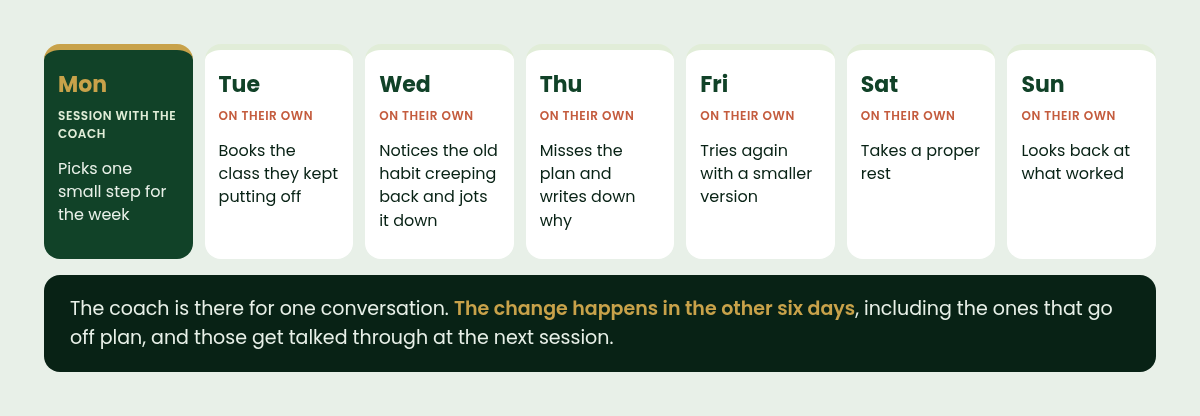
The main principle behind how life coaching works is collaboration, your coach helps you reflect, set goals, and stay accountable, while you put the agreed-upon actions into practice. Progress comes from applying what you learn between sessions, not simply from attending meetings.
Most of the work in coaching happens away from the call, as this sample week shows.
A life coaching session is a dedicated conversation focused on your goals, current challenges, and the steps you can take to make progress. Rather than following a rigid script, the coach typically adapts the discussion to your needs and what has happened since your previous meeting.
Although the format varies between coaches, a session often includes a few key activities.
The session may begin with a check-in about what has been happening in your life. You can discuss a recent decision, a challenge you are facing, or progress toward a goal you established earlier.
Your coach may ask what has gone well, what feels difficult, and which issue you would like to focus on. This helps establish a clear direction for the conversation.
Your coach may use open-ended questions to help you examine your thoughts, assumptions, and available options. Instead of immediately recommending a solution, the coach encourages you to consider what matters to you and why a particular situation feels challenging.
For example, if you struggle to say no to additional responsibilities, the conversation might explore what you fear could happen if you set a boundary and what alternatives are available.
Toward the end of the session, you and your coach may identify one or more actions to work on before your next meeting. These should be realistic enough to fit into your everyday routine.
Imagine you want to become more confident when sharing ideas at work. You might agree to contribute one suggestion during your next team meeting and reflect on the experience afterward.
At the following session, you can discuss what happened, what you learned, and whether another approach would be more useful.
Life coaching may take place through video calls, telephone conversations, or face-to-face meetings, depending on the coach's services and your preferences. Online coaching can be convenient if you have a busy schedule or prefer to speak from a familiar environment.
The important consideration is whether the format allows you to communicate comfortably, reflect openly, and participate consistently.
A life coaching session is not simply a conversation about your problems. It is an opportunity to understand your situation, explore possible solutions, and leave with a clearer idea of what you want to do next.
Life coaching can support different areas of personal and professional development, depending on your priorities and the experience of the coach. Some people seek coaching because they want to make a significant change, while others want to improve everyday habits, make better decisions, or feel more confident about their direction.
Here are some common areas where life coaching may be useful.
You may know what you want to achieve but hesitate because you doubt your abilities or worry about making mistakes. A life coach can help you examine these concerns, recognise your strengths, and identify practical ways to approach challenging situations.
If you regularly avoid opportunities because you fear criticism, coaching may help you explore what is holding you back and develop a plan to take manageable steps outside your comfort zone.
Career uncertainty can arise when you feel dissatisfied with your current role, struggle to identify your next step, or find it difficult to balance professional ambitions with personal priorities.
A life coach can help you clarify what matters to you in your working life, evaluate your options, and establish goals that reflect your interests and circumstances. Coaching can support decision-making, although it does not replace specialist career advice when technical or industry-specific expertise is needed.
Communication habits, personal boundaries, and recurring disagreements can affect how you interact with others. Depending on the coach's qualifications and scope of practice, coaching may help you recognise your communication patterns, clarify your expectations, and practise expressing your needs more effectively.
For instance, someone who finds it difficult to communicate their preferences may work on expressing themselves more clearly and respectfully.
Life coaching is not a substitute for couples therapy or specialist support when relationships involve serious conflict, abuse, or complex emotional difficulties.
Sometimes, meaningful progress comes from changing everyday behaviours rather than making a major life decision. You might want to manage your time more effectively, establish a consistent routine, or create clearer boundaries between work and personal life.
A coach can help you identify what is disrupting your routine, set realistic priorities, and build an action plan that fits your schedule.
The right coaching focus depends on what you want to change. Before beginning, it is useful to identify your priorities and discuss whether the coach has relevant experience supporting those goals.
Life coaching provides a structured way to understand your priorities, work through challenges, and make progress toward personal or professional goals. Through guided conversations, goal-setting, and regular progress reviews, a life coach helps you approach decisions more intentionally and identify practical ways to move forward.
The benefits depend on your goals, circumstances, and willingness to apply what you learn. The following table summarises some of the main ways life coaching may support personal development.
| Benefit | How life coaching can help |
|---|---|
| Goal clarity | Helps you identify priorities and establish meaningful, realistic goals. |
| Self-awareness | Encourages you to recognise habits, assumptions, and behaviours that influence your decisions. |
| Accountability | Provides a structured opportunity to review commitments and maintain progress. |
| Decision-making | Helps you evaluate options and make choices that align with your values. |
| Confidence | Encourages you to recognise your strengths and approach challenging situations more deliberately. |
| Consistent habits | Helps you break larger goals into manageable actions and review your routines. |
| Work-life balance | Supports clearer priorities and more intentional boundaries between professional and personal responsibilities. |
When several areas of life demand attention, deciding what to prioritise can become difficult. Coaching gives you dedicated time to examine your goals, understand your motivations, and identify what deserves your attention. This clarity can make it easier to direct your time and energy toward meaningful objectives.
Your everyday decisions are often influenced by habits, assumptions, and familiar ways of responding to challenges. A coach can help you examine these patterns and consider whether they support your goals. Recognising them allows you to make more deliberate choices rather than repeating behaviours automatically.
Maintaining motivation can be challenging when progress takes time. Regular sessions give you an opportunity to review your commitments, discuss setbacks, and decide what to do next. This structure can help you stay focused and adjust your approach when your original plan is not working.
Important decisions can feel overwhelming when several options seem possible. Coaching helps you clarify your priorities, examine alternatives, and consider the potential consequences of different choices. Although a coach cannot guarantee the right outcome, the process can help you make decisions with greater awareness.
Meaningful change often develops through small, repeated actions rather than dramatic decisions. A coach can help you translate long-term goals into manageable steps, monitor your progress, and make adjustments as your circumstances evolve.
Life coaching is not a guarantee of success. Its value lies in providing structure, reflection, and accountability so you can make informed decisions and take purposeful action toward the changes you want to achieve.
A life coach and a therapist can both help people work through challenges, understand their experiences, and make changes in their lives. However, they differ in their training, professional responsibilities, and the type of support they provide. Understanding these differences can help you decide which approach better suits your needs.
| Area of comparison | Life Coach | Therapist |
|---|---|---|
| Primary focus | Personal development, goals, and future actions | Mental health, emotional difficulties, and psychological well-being |
| Typical approach | Goal-setting, reflective questions, action planning, and accountability | Evidence-based therapeutic approaches tailored to the person's needs |
| Main objective | Help clients clarify priorities and work toward desired changes | Assess and address psychological concerns and emotional distress |
| Professional qualifications | Training and credentials vary; the coaching title is not a mental health licence | Qualifications and licensing requirements depend on the profession and jurisdiction |
| Typical topics | Confidence, decision-making, habits, career direction, and personal growth | Anxiety, depression, trauma, persistent emotional distress, and other mental health concerns |
Life coaching may be suitable when you want to clarify your goals, improve your routines, make a personal decision, or develop greater accountability. It can provide a structured environment to explore your options and identify practical steps toward change.
The focus is generally on your current circumstances, desired future, and the actions that can help you move forward. Coaching may also complement other forms of professional support when the roles and boundaries are clear.
Therapy may be more appropriate when you are experiencing persistent emotional distress, symptoms of a mental health condition, trauma-related difficulties, or problems that significantly affect your daily functioning. A qualified mental health professional can assess your needs and recommend suitable treatment or support.
Life coaching is not a substitute for mental health assessment or treatment, and a life coach should refer clients to an appropriate professional when concerns fall outside their competence.
For a more detailed comparison, read Muse Coaching's article on coaching and counseling.
The key difference is the type of support you need. Life coaching generally focuses on personal goals and forward-looking action, while therapy can address mental health concerns and emotional difficulties. Choosing the appropriate professional depends on your circumstances rather than which approach appears more appealing.
Life coaching may be a good fit if you want to make a change in your life but need help clarifying your priorities, exploring your options, or turning your intentions into practical steps. It can be particularly useful when you feel ready to move forward but struggle to maintain direction or consistency on your own.
People interested in life coaching as a career may also want to understand its earning potential. Income can vary depending on a coach's experience, specialisation, pricing, client base, and working arrangements.
Read this guide to life coach salaries and earning potential for more information about the financial side of the profession.
You may benefit from life coaching if you:
However, life coaching is not the right solution for every situation. It requires a willingness to reflect honestly, participate in conversations, and take action between sessions. A coach can guide the process, but you remain responsible for your decisions and progress.
It is also important to consider the coach's experience, approach, professional boundaries, and suitability for your goals before committing to sessions. Ask how they structure their coaching, what you can expect from the process, and how they handle situations that require support beyond their expertise.
The final decision depends on what you want to achieve and the type of support you need. A clear understanding of your goals and realistic expectations can help you determine whether life coaching is a useful next step.
Life coaching provides a structured way to understand your priorities, work through challenges, and take meaningful steps toward personal or professional goals. A life coach helps you explore your options, develop practical action plans, and stay accountable as you work toward the changes you want to make.
Understanding what a life coach does and how life coaching works can help you decide whether this type of support suits your needs. While coaching cannot guarantee results or replace professional mental health care, it can offer valuable guidance when you are ready to make deliberate changes.
The most important step is identifying what you want to improve and finding an approach that aligns with your goals, circumstances, and expectations.
A life coach is a professional who helps people clarify their goals, overcome obstacles, and develop practical strategies for personal or professional growth.
A life coach helps clients identify priorities, set achievable goals, explore challenges, create action plans, and maintain accountability for their progress.
Life coaching works through structured conversations, goal-setting, action planning, and regular progress reviews to help clients move toward their desired outcomes.
A typical session involves discussing current challenges, exploring possible solutions, reviewing progress, and identifying practical actions to take before the next meeting.
People seeking greater clarity, improved decision-making, healthier habits, increased confidence, or better work-life balance may benefit from life coaching.
Life coaching may last a few sessions or several months, depending on the client's goals, progress, and preferred session frequency.
No. Life coaching generally focuses on personal goals and future actions, while therapy addresses mental health concerns and emotional difficulties through appropriate therapeutic approaches.
Yes. A life coach can help you recognise your strengths, examine self-limiting patterns, and develop practical strategies for approaching challenging situations with greater confidence.
Yes. Many life coaches offer sessions through video calls or telephone, allowing clients to receive coaching remotely, depending on the coach's services.
No. Life coaching cannot guarantee specific outcomes. Results depend on factors such as your goals, circumstances, participation, and willingness to apply what you learn.