
A practical guide for coaches on how to become an online fitness coach, covering certification, scope, coaching models, real market prices, income math and how to land your first clients.
Ready to Find Your Coach?
Become a Muse CoachLearning how to become an online fitness coach starts with a recognized personal trainer certification, one client group, a simple monthly offer and a platform that handles video, check-ins and payments. The median price for one-to-one online coaching is $183 a month.
Online fitness coaching lets you train people in any city without renting gym space. The hard part is rarely the workouts. It is knowing what training you need, what to sell and what price people will pay.
This blog covers both halves, from certification and scope to pricing, income and your first clients.
Keep reading to see why raising your price often beats chasing more clients.
Here are the key facts in one place. Each figure is explained and sourced further down.
| Detail | What to Know |
|---|---|
| What the work is | Coaching clients through training plans, check-ins and video sessions without sharing a gym |
| Certification | No single national license in the US, but personal trainers are usually expected to be certified |
| Safety basics | Current CPR and AED training plus a health screening before the first workout |
| Typical monthly price | A median of $183 a month for one-to-one online coaching |
| Middle half of prices | $118 to $250 a month |
| US median price | $199 a month |
| Lower price formats | Group coaching at a median of $89 a month and program subscriptions at $59 a month |
| Pay benchmark | Fitness trainers and instructors earn a median of $47,160 a year |
| Fastest way to start | One client group, one 12-week offer and a small paid pilot |
An online fitness coach plans training, checks progress and keeps clients consistent from a distance. The coaching happens over video calls, messages and workout logs instead of on a gym floor. Most of the job is reviewing what each client actually did that week and adjusting the plan to keep progress coming.
A typical client gets a plan built around their goal, schedule and equipment. They train on their own, log what they did and send short videos of their form. The coach reviews the data, adjusts the plan and checks in when a week goes off track.
Good online coaches spend as much time on habits as on exercise. A client who trains three times a week for six months will beat a perfect plan that lasts two weeks.
Some fitness coaches go further and learn how to become a mindset coach so they can help clients with motivation and self-talk.
The biggest change is that you are not in the room. That shifts your job from watching every rep to building systems that work while you are away.
| In Person | Online |
|---|---|
| You correct form on the spot | You review filmed sets and send clear cues |
| The gym supplies the equipment | Every client has different equipment at home or at the gym |
| The booked session creates the habit | Reminders and check-ins create the habit |
| Clients live nearby | Clients can live in any time zone |
| You are paid per session | You are usually paid per month |
Recording clear demos at home is part of everyday work for many online coaches.
You do not need a government license to coach fitness online in most of the US, but you should still get certified. Clients, insurers and employers treat a certification as basic proof that you can train people safely. It often decides whether a stranger trusts you enough to pay.
Data from the US Bureau of Labor Statistics shows that employers generally expect trainers to hold a certification before taking on clients. Many also want proof of CPR, first aid and AED training.
Certification carries extra weight when clients cannot meet you. It is one of the few signals a stranger can check before paying you.
Pick a program whose exam carries accreditation from the National Commission for Certifying Agencies, or NCCA. Well-known examples include NASM, ACE, ISSA and ACSM.
General coaching works differently, and the rules on whether you need a certification to be a life coach are looser than those for training clients.
Clear limits protect your clients and your business. Write them into your intake and your coaching agreement before the first session.
The PAR-Q+ is a free, widely used screening questionnaire you can add to every new client intake.
Knowing the key differences between coaching and counseling makes it easier to spot when a client needs clinical care instead.
If you are figuring out how to start online fitness coaching from zero, these steps take you to a working practice. Many coaches work through them alongside another job.
Start with a personal trainer certification that has an accredited exam. Then keep your CPR and AED training current, because many insurers and employers ask for both.
If you already hold a certification, add a specialty that matches the people you want to coach. Popular specialties include senior strength training, prenatal and postpartum fitness and endurance coaching.
Clients can find thousands of free workouts online. A clear client group is what gives them a reason to pay you instead.
Describe your client in one sentence. For example, busy parents who train at home with dumbbells, or desk workers who want to lift without back pain. Your niche shapes your programs, your content and the referrals you get.
Your model decides how your week feels and how many clients you can serve. Choose one to start and add others later.
A good intake saves hours later and keeps clients safe. It also helps you decide whether someone is a good fit before you take their money.
Ask about goals, training history, injuries, medications, equipment, schedule and what has stopped them before. Add a health screening and ask for medical clearance when it is needed.
Twelve weeks is long enough to show real progress and short enough for a client to commit. It also gives you a clear start and finish to plan around.
Spell out what the client gets. That means how often the plan changes, how many check-ins they get, how fast you reply to messages and what a finished program looks like.
Clients judge you on how easy it is to book, pay and show up. Clunky admin costs you clients before the coaching even starts.
You need a calendar, a payment system, video calls, messaging and a place to deliver plans. You can stitch these tools together yourself or use one platform that handles all of them.
Once bookings start coming in, a few simple coaching scheduling habits will cut no-shows and double bookings.
A small pilot tests your offer before you market it widely. Offer a few spots at a lower price in return for honest feedback and a testimonial.
Track what clients actually do. Look at how many workouts they log, which check-ins they skip and where they get stuck. Fix those gaps before you raise your price.
Your first clients usually come from people who already know you. Former gym clients, friends of friends and your own community are the warmest start.
Share short, useful posts for your client group, ask happy pilot clients for referrals and make booking a free intro call simple.
When referrals slow down, there are plenty of proven ways to get coaching clients online and keep your calendar full.
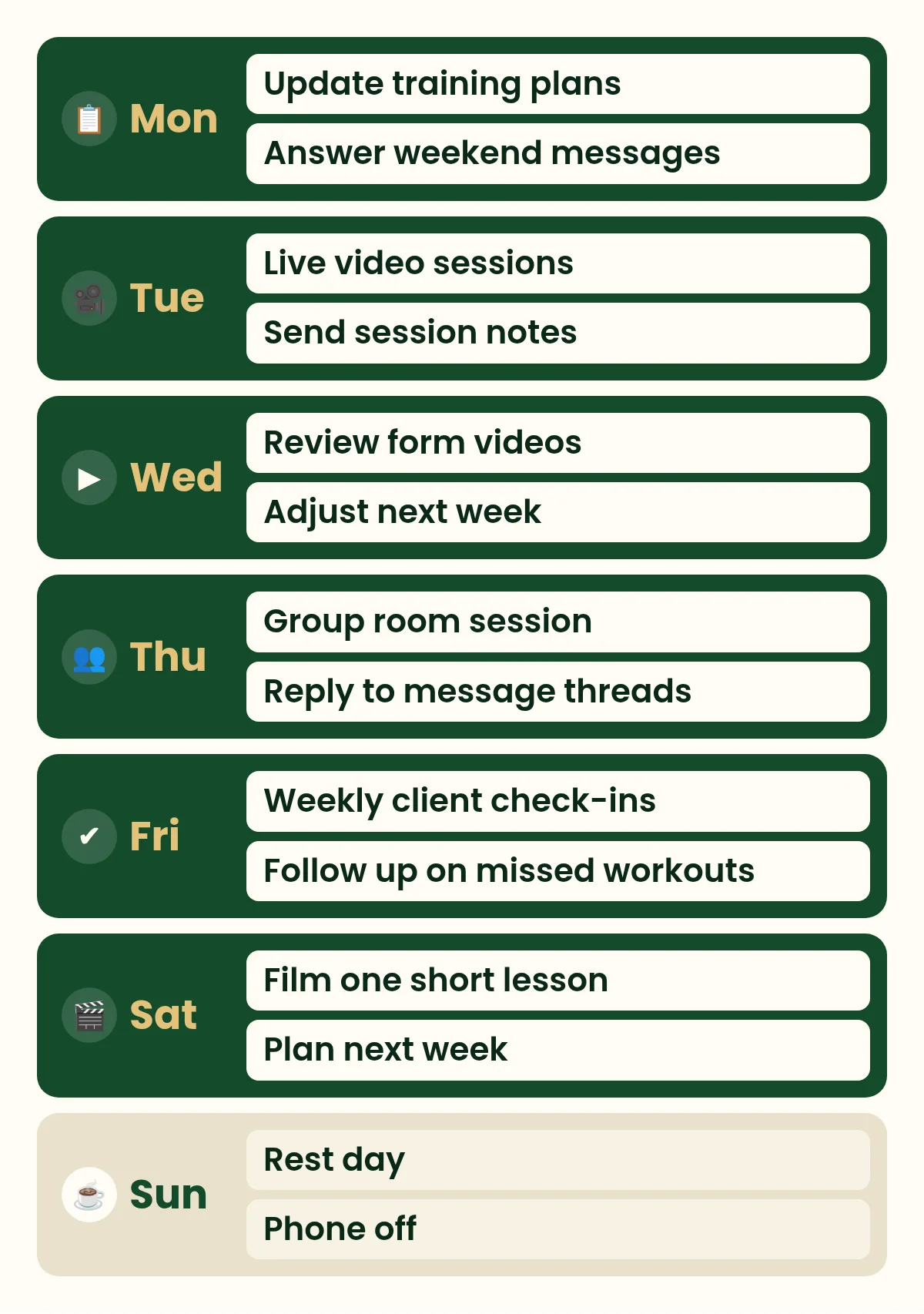
Once your first clients are on board, the next challenge is fitting the work into a normal week. The planner below shows a sample part-time week for an online fitness coach.
Each day has one main job. Monday is for updating client plans, Tuesday is for live video sessions and Wednesday is for reviewing form videos.
Thursday is a group session, Friday covers client check-ins, Saturday is for filming a short lesson and Sunday stays free for rest.
Grouping similar tasks like this stops you from jumping between jobs all day. It also leaves room to take on more clients without burning out.

Most online fitness coaches charge between $118 and $250 a month for one-to-one coaching, with $183 as the typical midpoint. Coaches based in the US price a little higher, at a median of $199 a month, while group plans and program subscriptions cost far less.
These figures come from an OnlineFitness.app pricing study of 807 online coaches who publish a monthly price on their own website.
The same study found that one in six coaches starts at $300 a month or more, while only 2% start at $500 or more. Most prices cluster between about $100 and $250 a month.
Format changes the price more than location does. A coach who reviews every workout can charge far more than a coach who sells a prebuilt plan.
| Format | Median Price |
|---|---|
| One-to-one online coaching | $183 a month |
| Hybrid coaching with in-person sessions | $257 a month |
| Nutrition coaching only | $150 a month |
| Group coaching | $89 a month, from a small sample of 22 coaches |
| Training program subscription | $59 a month |
| App or membership | $32 a month |
| One-time training program | $94 |
| One in-person session | $70 |
Each coach appears only once in each format, using their lowest regular rate.
Many coaches sell fixed packages instead of open monthly plans. Packages make the commitment clear and reduce early dropouts.
The study found a median of $594 for a package lasting 12 to 13 weeks, with the middle half between $363 and $966. Six-month packages had a median of $1,352. Per month, packages land close to regular monthly pricing.
Plenty of coaches never show a price on their website. Instead, they send visitors to an application form or a discovery call.
When the researchers checked 555 more coach websites, only 36% listed a price, while 57% pushed visitors to fill in a form, schedule a call or get in touch. Hiding the price lets a coach qualify leads, but it also turns away people who want to compare options quickly.
If you would rather show clear rates and let clients book you directly, you can set up your fitness coaching offers on Muse with prices visible from the start.
Knowing how much online fitness coaches charge is only the first half. These steps help you land on a price that covers your time and still feels fair to clients.
Start with the hours you spend on one client each month. Count plan updates, check-ins, message replies and video calls, not just sessions.
A client who gets weekly calls and daily messages needs a much higher price than one who gets a monthly plan update. If your price does not cover the hours, you will burn out before you grow.
Use the market medians as a reference point, not a rule. A US coach offering weekly reviews and messaging at $199 a month sits right at the middle of the market.
Price below the middle half if you are new and testing your offer. Move toward the top when you have results, testimonials and a clear niche.
Tiers let clients choose how much support they want without you dropping your price. They also give you room to upsell.
Coaches offering several tiers set the highest one at about 1.67 times the price of the entry option. The median entry tier was $157 a month and the median top tier was $273 a month.
Not every client can pay for full one-to-one coaching. Lower-priced formats bring those people in and often lead to upgrades later.
Group coaching, program subscriptions and paid message threads let you serve more people per hour. They also smooth out your income when one-to-one clients pause.
Your first price should not be your forever price. Review it when your calendar fills, when you add a new skill or when clients get better results.
Raise prices for new clients first. Give existing clients notice before any change so you keep their trust.
Online fitness coach salary is not tracked by any government survey on its own, since most online coaches are self-employed. Your income comes down to how many clients you keep, what they pay each month and what it costs to run your business. Most coaches grow it one client at a time.
The US Bureau of Labor Statistics puts median pay for fitness trainers and instructors at $47,160 a year, or $22.67 an hour.
In the same data, the lowest 10% earned less than $28,800 and the highest 10% earned more than $83,100.
That figure mostly reflects employed trainers, because BLS wage data does not include self-employed workers. Treat it as a benchmark, not a ceiling.
The table below is simple multiplication using the study's monthly prices. It shows monthly revenue before platform fees, software, insurance and tax.
| Active Clients | At $118 a Month | At $183 a Month | At $250 a Month |
|---|---|---|---|
| 5 | $590 | $915 | $1,250 |
| 10 | $1,180 | $1,830 | $2,500 |
| 20 | $2,360 | $3,660 | $5,000 |
| 30 | $3,540 | $5,490 | $7,500 |
Raising your rate grows income faster than adding clients. Going from $183 to $250 with 20 clients adds $1,340 a month without adding a single client to program. Many new coaches underprice and try to fix it with more clients, which only adds hours.
Fitness is one niche among many, and a typical life coach salary shows how earnings compare across coaching more broadly.
Four things decide whether your online fitness coaching business pays well. Most of them are in your control.
You can coach online as an employee or contractor for an app or company, or you can run your own practice. Each path suits a different stage.
| Online Fitness Coach Jobs | Your Own Practice |
|---|---|
| Clients are supplied for you | You find or attract your own clients |
| The company sets your rate | You set your own rates |
| Fixed programs and scripts | Your own methods and offers |
| Less admin to manage | More admin unless a platform handles it |
| Less control over your schedule | Full control over your hours |
Remote fitness coach jobs can be a good way to build experience and confidence. Many coaches later move to their own practice once they have results and a client base.
When you are ready to go independent, the full setup for an online coaching business covers offers, tools and launch in more detail.
Keeping clients matters more than finding new ones. A full roster built on short stays forces you to keep selling every month.
Muse is a coaching platform where you can run your online fitness coaching business without building the tech yourself. You keep control of your offers, clients and prices.
Clients who want help with sleep, movement and daily routines already book lifestyle coaching on Muse.
Browsing the Muse coach directory shows how coaches in the Health and Fitness category present their profiles.
Apply to become a Muse coach and start building your online fitness coaching practice on your own terms.
Learning how to become an online fitness coach comes down to two jobs. You need to coach people safely and well, and you need to run a business that charges enough to last.
Start with a recognized certification, one clear client group and a simple 12-week offer. Use real market prices as your guide, then raise them as your results grow. Keep your admin light and spend your hours on coaching, because income follows the clients you keep.
These answers cover the questions new coaches ask most about training, pricing and income.
There is no single national license for fitness coaching in the US, yet most clients, insurers and employers expect a recognized personal trainer certification. Choose a program whose exam is NCCA-accredited, such as NASM, ACE, ISSA or ACSM, and renew your CPR and AED training before it lapses.
Most one-to-one online coaching sells for $118 to $250 a month, and the median sits at $183. If your offer includes weekly reviews and messaging, start near the middle of that range, then raise your rate as client results, testimonials and demand grow.
Online coaches have no official salary figure because most of them are self-employed. As a benchmark, the Bureau of Labor Statistics reports that fitness trainers and instructors earn a median of $47,160 a year. Your own income equals active clients times monthly price, minus platform fees, software, insurance and tax.
NASM says most candidates finish its personal trainer certification in four to six weeks. After that, many new coaches spend a few months shaping an offer, running a small paid pilot and setting up booking before they launch fully. Coaches who already hold a certification can often start much sooner.
It can, and many coaches begin this way. Selling a custom plan with weekly check-ins works well next to a day job, since you can review logged workouts and reply to messages at times you choose. Begin with a handful of clients and a single offer, then add spots as your schedule opens up.
In most places, online fitness coaches can share general healthy eating guidance such as protein targets, hydration and balanced meals. Meal plans for medical conditions belong with a registered dietitian, and the rules vary by state, so check your local laws before you add nutrition services to an offer.
The terms overlap, and many people use them interchangeably. An online personal trainer often focuses on writing workout programs, while an online fitness coach usually adds habit coaching, accountability and regular check-ins. Clients searching for either title tend to want the same result, a plan that fits their life and someone who keeps them on track.
Usually, yes. A month of one-to-one online coaching at the $183 median is priced close to two or three in-person sessions, which run about $70 each. Online clients also get a full plan, weekly reviews and messaging between check-ins, so the value per dollar is often higher.

