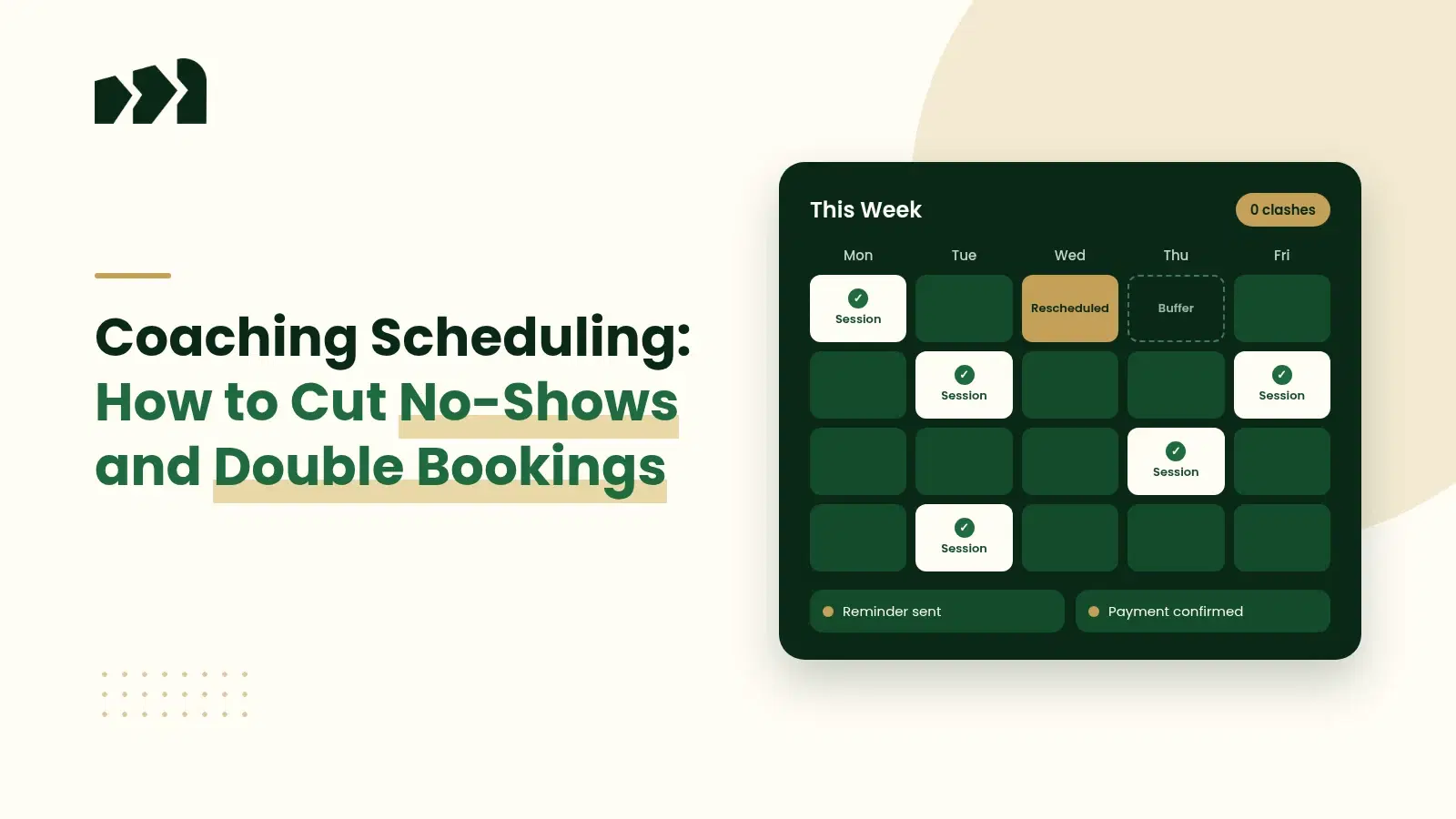
A practical coaching scheduling guide for coaches who want fewer missed sessions, no clashing bookings, a cancellation policy clients respect and a calendar that handles time zones.
To cut no-shows and double bookings, take payment when a client books, send two reminders with a reschedule link and route every booking through one calendar that sees all your busy time.
These habits fix most coaching scheduling problems before they start.
Yet many coaches lose hours each month to empty video calls, clashing bookings and clients who got the time zone wrong. This guide covers why clients miss sessions, how to write a cancellation policy people respect and how to build a calendar that cannot double book.
The coaches with the fewest empty calls do not have better clients. They have a better system, and the part most of them skip takes five minutes a month.
These are the key numbers from this guide in one place, so you can check your own setup before reading on.
Coaching scheduling is every step between a client deciding to book and the two of you meeting on a call. It covers your open hours, how clients pick a time, what they pay up front, which reminders they get and what happens when plans change. The booking link is the smallest part of it.
Two problems do most of the damage. A no-show leaves you on an empty call with an hour you cannot sell again. A double booking forces you to cancel on someone, which hurts trust far more than a late start. Both come from gaps in a system, not from bad clients, so both can be fixed.
If you are still setting up your practice, read our guide on how to start an online coaching business first and come back once clients begin to book.
Good coaching scheduling starts with knowing why sessions get missed. Most misses trace back to a handful of causes that repeat in every coaching niche.
Only the last cause is about the coaching itself. The other four are coaching scheduling problems, which is why the fixes below start with the system.
Each fix below closes one gap in your coaching scheduling. Start with the first two, since they deal with the most common reasons clients miss sessions, then add the rest as your client list grows. The table matches each cause with the fix that targets it.
| Why Clients Miss Sessions | Fix That Targets It |
|---|---|
| They forgot the session | Send reminders that carry everything (Fix 2) |
| The time zone tripped them up | Show the time in the client's own zone in every reminder (Fix 2) |
| Nothing was at stake | Take payment when the client books (Fix 1) |
| Moving it felt awkward | Make rescheduling easy before the cutoff (Fix 6) |
| Momentum faded | Agree on the next date before the call ends (Fix 3) |
| The booking was weeks away | Keep the gap between booking and session short (Fix 5) |
| Every week was a new decision | Give regular clients a standing slot (Fix 4) |
Payment at booking is the strongest single way to reduce no-shows. A client who has already paid has a reason to turn up, and you are not left chasing an invoice after a missed hour. For packages, collect the full package or the first month before the first session.
For a first call, a small deposit that counts toward the first paid session works too. The amount matters less than the act of committing.
Reminders fix forgetting, and they are the easiest part of coaching scheduling to automate. A Cochrane review of eight randomised trials found that text reminders lifted appointment attendance from 67.8% to 78.6% compared with no reminder. Coaching is not a clinic, but the pattern holds.
Send one reminder about 48 hours before, while there is still time to move the session, and a short one on the day. Each message should name the date, the time in the client's own zone, the video link and a one-click way to reschedule. Wording counts too.
In two NHS trials published in PLOS One, reminders that stated the cost of a missed appointment cut missed visits from 11.1% to 8.4%. For a coach, a plain line such as "this hour is held just for you" does the same job without sounding stern.
The easiest booking you will ever get is the one made while the client is still on the call. Save the last three minutes of each session to agree on the next date and time. The client leaves with a date in their calendar instead of a vague plan to sort it out later.
A standing slot is the simplest coaching scheduling habit there is. A client who meets you every Tuesday at 6 p.m. stops treating the session as a decision. It becomes routine. Once a client has done two or three sessions, offer a fixed weekly or fortnightly slot and hold it for as long as they stay.
The longer the wait, the higher the chance that something else claims the slot. A first call booked three weeks out competes with everything that comes up in those three weeks. Keep a few openings within the next five days for new clients.
Short gaps also help first calls turn into paying clients, a step our guide on how to get coaching clients covers in depth.
A client who can move a session in ten seconds usually will, rather than just not turning up. Put a self-service reschedule link in every confirmation and reminder, and let it work right up to your notice cutoff.
After the cutoff, the link closes and your cancellation policy takes over. Flexibility and boundaries then live in the same coaching scheduling system.
How you respond to the first miss decides whether there is a second. Send one calm message within 24 hours that offers a new time and asks if anything got in the way. Keep blame out of it.
If a client misses twice in a row, raise the pattern on your next call, because it usually says something about their goals rather than their calendar.
A coaching cancellation policy turns "please let me know" into a clear agreement. Without one, every late cancellation becomes a fresh negotiation, and you absorb the cost to avoid an awkward talk.
Keep it short enough that a client will actually read it. A strong policy covers six points.
A policy only works when it is built into your coaching scheduling from the first booking. Share it in three places so nobody is caught off guard. Put it in your coaching agreement, on your booking page and as a single line in each confirmation.
Use the wording below as a starting point and adjust the numbers to suit your practice.
Your session time is reserved for you alone. You can cancel or move a session for free up to 24 hours before it starts, using the link in your confirmation. Changes made with less notice, and sessions missed without notice, are charged in full. If you join late, we still finish at the booked time. If I cancel at short notice, your next session is free. Genuine emergencies are handled case by case.
A policy that only binds the client feels one-sided, and clients notice. Adding a rule for yourself costs very little and makes the whole policy easier to accept. Offer a free session or a credit when you cancel inside your own notice window, and put that promise in writing.
Double bookings almost always happen because your booking tool cannot see your whole life. A dentist visit in a personal calendar, a client booked by email or a call you added from your phone can all slip past it. The fix is one coaching scheduling setup that sees every commitment you have.
Pick one calendar where all coaching sessions land and make it the centre of your coaching scheduling. Every new booking, from any source, should be written there. When you need to check your week, this is the only place you look.
Your booking tool needs to read every calendar you use, not just the work one. That includes personal, family and second job calendars. Most tools can share busy time without showing event details, so clients see a closed slot but never the reason behind it.
Many double bookings start with a session agreed in a direct message or an email thread that never got logged. Send every client, new or returning, to the same booking link, even when they ask for a time in a chat. One way in means one calendar that is always right.
Availability rules protect the time around each session, not just the session itself. Add a 10 to 15 minute buffer between calls for notes and a break. Set a minimum notice period, such as 12 or 24 hours, so last-minute bookings cannot catch you off guard, and cap the number of sessions per day so a busy week cannot pile up.
Add a dummy event to your personal calendar, load your booking page in an incognito window and confirm the slot no longer shows. Repeat the test any time you change tools or add a calendar.
Online coaching means clients can live anywhere, and scheduling coaching clients across time zones causes many avoidable mix-ups. A client is sure the call was at 4 p.m., and they are right, just in a different city. A few habits remove most of this confusion from coaching session scheduling.
Coaching scheduling also covers the shape of the sessions themselves. Sessions that run too long, come too often or sit at awkward hours are harder to keep. Getting length, frequency and weekly load right makes every other fix work better.
Most one-to-one coaching sessions run 45 to 60 minutes. That is long enough to review progress, work through one real issue and agree on a next step. First calls work well at 20 to 30 minutes, and short check-ins at 15 to 20.
Weekly sessions suit clients in the middle of a big change, since momentum matters most early on. Once a client is putting ideas into practice, every two weeks gives them time to act between calls. Monthly sessions fit clients who mainly need to stay on track.
Plan your capacity before your calendar fills, not after. Most full-time coaches on Muse work four to six client-facing hours a day, and the rest goes to notes, content and rest. Grouping calls into blocks also means fewer half-hour gaps that are too short to use well.
Tracking takes five minutes a month and shows whether your fixes are working. Divide missed sessions by booked sessions and multiply by 100. A coach with 4 no-shows out of 50 booked sessions has a no-show rate of 8%.
Keep late cancellations as a separate number, since they need a different fix. Then look for patterns. If most misses fall on Monday mornings, on first calls or among clients in one region, you know exactly which part of your coaching scheduling to adjust first.
Every coaching scheduling fix above can be built by hand with a calendar app, a payment tool and a video link. Muse puts it all in one coaching platform instead, so coaches spend their time on clients rather than admin. Here is how the platform takes care of coaching appointment booking.
Coaches on Muse work as independent contractors with no exclusivity, so you can keep seeing clients elsewhere or bring existing clients onto the platform. Every session is between one human coach and one human client. To have scheduling handled while you focus on the coaching, you can apply to become a Muse coach in about ten minutes.
A calendar that runs quietly in the background tells clients you take their time seriously. Take payment at booking, send reminders with a reschedule link, publish a fair cancellation policy and let one calendar see everything. Then check your no-show rate each month.
Good coaching scheduling will not make you a better coach, but it gives your coaching the steady attendance it needs to work.
Most coaches charge the full session fee for a no-show and either half or the full fee for a late cancellation. Clients rarely object when the fee is stated before the first booking and applied the same way every time. Package clients usually lose the missed session rather than paying an extra charge.
Most coaching cancellation policies ask for 24 hours of notice, and some use 48 hours for longer or more intensive sessions. Pick a window that gives you a fair chance to fill the slot and fits the rest of your coaching scheduling. Then show it on your booking page, in your coaching agreement and in every confirmation message.
Ten to fifteen minutes is the usual wait. At the start time, send one short message with the video link in case the client is having trouble joining. If they have not joined or replied by your stated cutoff, end the call, mark the session as missed and follow up the next day.
Most one-to-one coaching sessions last 45 to 60 minutes, which is enough to review progress, work on one real issue and agree on next steps. First calls usually run 20 to 30 minutes, while quick check-ins between full sessions can be as short as 15 minutes.
Weekly sessions work best at the start of coaching or during a big change, when momentum matters most. Every two weeks suits clients who need time to apply what they learn between calls. Monthly sessions fit clients who are mostly maintaining progress and want regular accountability.
Send every booking through one link and connect all your calendars, including personal ones, to your coaching scheduling tool. The tool then hides any slot where something is already on. Add buffers between sessions, set a minimum notice and test your booking page again after every change you make.

