
Turn your coaching expertise into a real business with practical steps for choosing a niche, creating your offer, setting prices, attracting clients, and building a strong online presence.
The coaching industry crossed $5 billion in annual revenue and now has more than 122,000 active practitioners worldwide, yet the average coach earns just under $50,000 a year from coaching, and in the most recent detailed data more than half reported under $30,000.
That gap is the first thing to understand before you start an online coaching business. The demand is real, but most coaches never build a business around the coaching.
Being good at coaching is not the constraint. The constraint is turning your expertise into a service people can find, book, and pay for, then running that service without drowning in admin. Starting is the easy part.
Getting clients, delivering consistently, collecting payments, and keeping people coming back is where most practices stall.
This guide covers how to start an online coaching business in 2026 from a standing start: choosing a niche, building one offer, pricing it against real market data, handling the business and legal basics, getting your first paying clients, and deciding which tools to run it on.
Where a platform like Muse fits, this guide says so, but most of what follows applies wherever you coach.
Key takeaways
- The coaching market is large and growing, but average per-coach income is modest. Results come from positioning and productizing your expertise, not from the market being hot.
- You do not need a website, a large audience, or a full tech stack to begin. You need one niche, one clear offer, and a way to get booked and paid.
- Price against the work and the outcome, not against what other coaches charge. The global average one-hour coaching fee is $234, but rates vary widely by specialty and experience.
- The business basics, meaning registration, payments, and a simple agreement, matter as much as the coaching. Skipping them is the most common early mistake.
- Start with one delivery format and one channel for finding clients. Expand only when there is clear demand.
An online coaching business is a service business where you help clients reach a specific goal through sessions and support delivered online, and charge for it. That is the whole of it.
The delivery can be video calls, messaging, group sessions, courses, or a mix, but the model is the same: your expertise, packaged as a paid service, delivered remotely.
Every online coaching business has two sides. One is the coaching experience the client sees. The other is the business system you run behind it: getting found, taking bookings, collecting payments, keeping client records, and following up.
Most new coaches focus entirely on the first side and neglect the second. The second side is what determines whether the practice survives past its first few clients.
The only real difference is the delivery infrastructure. Instead of a room, you need a reliable way to hold sessions, share resources, and stay in contact online.
Everything that actually decides whether you succeed, meaning your positioning, your pricing, your ability to get clients results, is identical to in-person coaching. Online delivery simply removes the geographic limit on who you can work with.
You need five things: a niche you genuinely understand, a specific client, an offer tied to a clear outcome, a way to deliver sessions, and a way to take bookings and payments.
Everything else, including a website, a brand, and marketing funnels, is optional at the start and can wait until you have paying clients.
The order matters. Coaches who begin by building a website or a logo, before they can say who they help and what problem they solve, spend money and weeks on work that does not bring in a single client. Get the first three decisions right and the rest becomes straightforward.
Niche test. If you cannot finish the sentence "I help [specific person] [achieve specific outcome]" without using the word "anyone" or "people," you do not have a niche yet. "I help mid-career professionals speak up in meetings" is a niche. "I help people with confidence" is not.
The steps below take you from a coaching idea to a working business. Do them in order. Skipping the business setup and client-acquisition steps is the main reason new coaches stay stuck at a handful of clients or quit before they get traction.
Pick the intersection of what you are genuinely good at and a problem people already pay to solve. You can base a niche on the type of person you help, the problem they face, or the outcome they want.
A narrow niche is easier to market, not harder, because it gives a specific person a clear reason to choose you over a generalist. Your niche does not lock in everything you will ever offer. It gives you a starting point and makes your content, offers, and messaging far easier to write.
If you want to see how working coaches frame their specialties, look at how coaches present their services on Muse.
Once you have a coaching area, get specific about who you want to work with. Describe their situation, their goal, what they have already tried, and what they are willing to pay for.
A useful description is far more specific than "adults" or "professionals." "Professionals who freeze in meetings" is something you can build an offer and a marketing message around. "People who want to grow" is not.
This single decision shapes your offer, your pricing, and every piece of marketing you will write, so it is worth doing properly before you move on.
Your offer turns your expertise into something a person can buy without having to message you first to understand it. Decide the format, meaning a single session, a package of sessions, or a structured program.
Then define the session length, the frequency, what is included, and the outcome it targets. Start with one offer. A client should be able to see what they get, how the coaching works, and what it costs before they contact you.
Launching one clear service is far easier than launching several, and your first clients will show you which format people actually want.
Set your price on the value and the work, not on undercutting other coaches.
The global average fee for a one-hour coaching session is $234, according to the ICF Global Coaching Study, but that figure spans new life coaches charging $50 to $75 a session and executive coaches charging several hundred dollars an hour.
Base your rate on your experience, your specialty, the session length, your preparation time, and the outcome you help clients reach. State the price clearly and state what is included.
Charging too little is not a safe choice: it signals low value and tends to fill your calendar with clients who are harder to work with. Raise your rates as your results and demand build.
This is the step most new coaches skip, and the one that causes real problems later. Register your business according to the rules where you live.
In the United States, that runs through your state and the Small Business Administration; elsewhere it runs through your local business authority. Choose a simple structure to start, which for most solo coaches is a sole proprietorship.
Keep your coaching income separate from your personal money with a dedicated account. Use a short client agreement that covers scope, payment, cancellation, and the fact that coaching is not therapy or medical advice.
Finally, check whether your specialty requires a license or professional insurance.
None of this is glamorous, but doing it early protects you once money and the occasional dispute enter the picture.
At a minimum you need four things: a way to hold sessions, a way for clients to book, a way to take payment, and somewhere to keep client notes. You can stitch these together from separate apps, or run them in one place.
Stitching separate tools together works at first, but it gets harder as your client list grows, because you spend time managing subscriptions and moving between logins instead of coaching.
A platform such as Muse combines profile, bookings, sessions, client messaging, payments, and community in one place, which is one way to set up a coaching practice on Muse without assembling a stack yourself.
Whatever you choose, keep the client's path from finding you to booking to paying as short as possible.
Your first clients rarely come from strangers. Start with the people you already know and ask for referrals. Offer a small number of discounted or free beta sessions in exchange for honest feedback and testimonials, because social proof is what convinces later clients to pay full price.
Publish content about the problem you solve rather than announcements that you are available; a few genuinely useful posts do more than constant self-promotion.
Pick one channel, whether that is a personal network, a social platform, or a community you are already part of, and work it consistently instead of spreading yourself thin across five. At this stage the goal is conversations and your first real results, not a large audience.
Once clients start booking, the quality of your coaching becomes the business. Prepare for each session against the client's goal and relevant notes from previous conversations. Keep the session focused but flexible enough to handle what actually comes up.
End every session with a clear next step, whether that is an action, a reflection, or preparation for the next meeting. If your offer includes support between sessions, set clear boundaries so it does not consume your week.
Repeat business and referrals come from results and a clean experience, not from discounts.
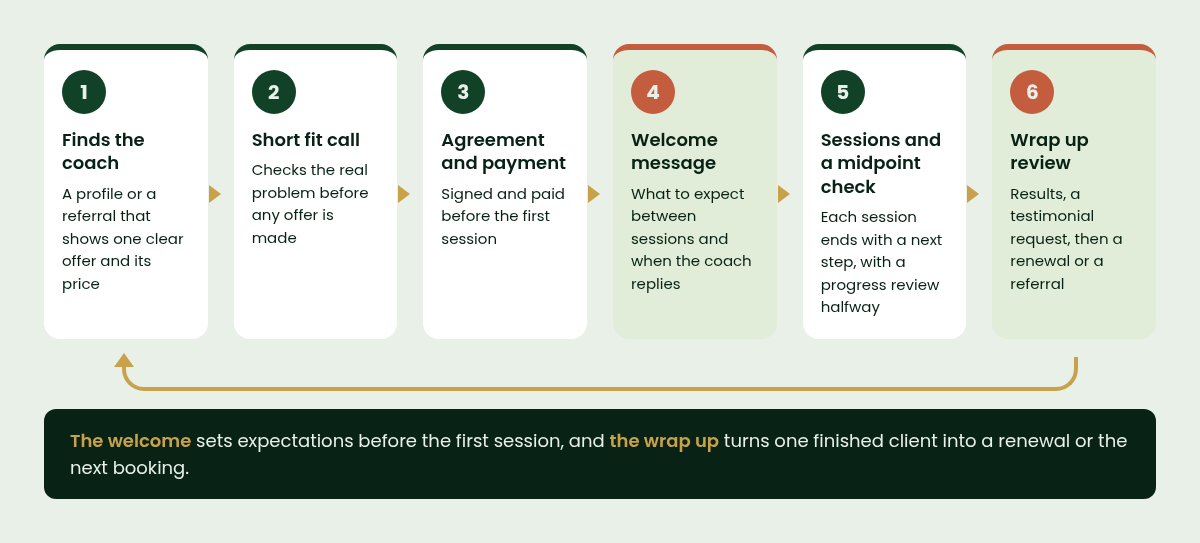
When you have clients, pay attention to which offers get booked, which clients return, where new clients come from, and how much of your schedule is filled. Use those patterns to adjust your pricing, your offers, and your availability.
Grow by productizing what already works, through packages, group coaching, or a course, rather than only adding one-to-one hours. Adding hours caps your income at the time you can work; productizing your expertise is what breaks that ceiling.
There is no single right model. The one you choose shapes your income, your time, and how many clients you can serve at once. Start with one and add others only when there is a clear reason. The table below compares the main options.
| Model | Best for | How income scales | What it demands |
|---|---|---|---|
| One-to-one coaching | New coaches and high-touch outcomes | Per session or package, capped by your available hours | The most personal time per client |
| Coaching packages | Clients who need a structured journey | Higher value per client and more predictable revenue | A defined process and clear outcomes |
| Group coaching | Shared goals and peer support | Serves several clients in the same hour | Facilitation skills and scheduling |
| Courses and programs | Repeatable, teachable knowledge | Sells without your live time | Upfront effort to build |
| Paid community | Ongoing support beyond sessions | Recurring membership revenue | Consistent engagement and moderation |
Most sustainable practices end up as a hybrid: one-to-one coaching or packages as the core, with a group program, course, or community added once the core is working. Muse supports these formats in one place, which makes it simpler to add a second offer without rebuilding your setup.
You can start an online coaching business for very little. The real starting costs fall into a few buckets, and most beyond the essentials are optional. The figures below are indicative and vary by provider and region.
| Cost | Typical range | Needed to start |
|---|---|---|
| Coaching platform or software | Free to around $50 per month | Yes, you need some tool to book, meet, and get paid |
| Payment processing fees | Around 2 to 3 percent per transaction | Yes, usually built into your platform |
| Video conferencing | Free to around $15 per month | Yes, unless it is bundled into your platform |
| Business registration | A low one-time or annual fee, varies by region | Yes |
| Certification | $0 to a few thousand dollars | Optional, depends on your specialty |
| Website and branding | $0 to ongoing | Optional at the start |
Lean starting stack. One platform that handles booking, sessions, and payments; a video tool, or a platform that includes one; a registered business; and a simple client agreement. That is enough to take your first paying client. Everything else can wait until money is coming in.
Globally, active coaches earn an average of about $49,283 a year from coaching, at an average fee of $234 per hour, working with around 12 active clients at a time.
Those figures come from the ICF Global Coaching Study. Averages hide a wide spread, though. In the 2025 study, Millennial coaches averaged $33,553 a year from coaching, while coaches with over ten years of experience averaged $69,721, and executive and specialized coaches earn well into six figures.
The gap is not usually about the hourly rate. It is about how much of your expertise you can sell beyond your live hours, and how well you position and keep clients. A coach who stays purely hourly caps income at the number of hours they can work in a week.
A coach who packages the work, runs groups, or adds a course or community serves more people with the same time and breaks that ceiling.
As a rough illustration, ten one-to-one sessions a month at a mid-range rate is a part-time income. The same hours split between a package and a small group can serve more clients for the same effort.
Your actual numbers depend on your rate, your client retention, and your mix of offers, not on any single figure. The point is that your business model, more than your rate, decides what you earn.
You do not need everything in place to begin. A focused first month moves you from an idea to an active coach with a live offer and your first conversations. The aim is not a perfect business. It is a clear starting point you can improve from.
Settle your niche, your ideal client, and the one problem you solve. By the end of the week you should be able to state clearly who you coach, what you help them achieve, and what you are offering.
If these are not clear, no amount of marketing later will fix it, so spend the first week on clarity rather than promotion.
Turn those decisions into a working setup. Create your profile or page, build one offer with a clear price, register your business, and set your availability. Before moving on, review everything from a potential client's point of view.
They should not have to guess who your coaching is for or what they will receive.
Begin actively looking for your first clients. Tell your existing network, offer a few beta sessions in exchange for testimonials, and publish a couple of useful posts about the problem you solve. Keep your message focused on that problem rather than on the fact that you are available.
The goal is to start real conversations, not to build a large following overnight.
Run your first sessions and learn from them. Note the questions clients ask before booking, which part of your offer draws the most interest, and where clients need more support. Use what you learn to refine your offer and profile.
After 30 days you should have a live offer, clear pricing, a registered business, and your first clients or conversations. Refinement comes from working with real clients, not from more planning.
A few avoidable mistakes make starting harder than it needs to be. Each one is common, and each one is easy to correct early.
A broad focus makes it hard for anyone to understand who you help, which makes you invisible in a crowded market. Choose a clear area and a specific client.
Several services at once split your attention and confuse potential clients. Begin with one clear offer and add packages, groups, courses, or a community once you understand what people want.
A low price signals low value and tends to attract clients who are harder to work with. Price on the outcome and the work, and raise your rates as your results build.
No registration, no client agreement, and no separate account for coaching income all cause real problems once money and the occasional dispute appear. Handle the basics before you take your first paying client.
You need an offer and a way to get booked, not a polished website. Clients pay for results, not for design. A site can come later, once you have paying clients.
Getting clients matters, but bookings are not the only goal. Repeat business and referrals come from client outcomes and a clean experience, so make sure the coaching itself is strong.
Adding new formats before your first offer is solid spreads you too thin. Prove that one service works, then expand from a position of strength.
The coaching market is large and still growing, but it rewards coaches who treat coaching as a business, not only as a skill. The income data makes the point plainly: most coaches never make that shift, which is exactly where the opportunity sits for the ones who do.
Start narrow. One niche, one client, and one offer, priced against real data, with the business basics handled and a short path from finding you to paying you. Get your first results and testimonials before you worry about scale.
Then productize what works, through packages, groups, or a course, so your income is no longer tied only to the hours you can sell.
Whether you build it from separate tools or run it in one place, the way to start an online coaching business in 2026 is to launch something specific, get real clients, and improve from there.
If you want a single environment for your profile, bookings, sessions, payments, and community, you can start building your coaching practice on Muse and refine it as your client base grows.

