A practical guide to parenting coach certification, covering what the work involves, how to choose training, where coaching ends, and how to start coaching parents.
A parenting coach certification is a training credential for people who want to coach parents, and it is not a government license. People become a parenting coach by learning coaching skills, studying family life, finishing serious training and practicing with feedback.
Many parents and caregivers want help with routines, conflict or a family change. They need a thinking partner, not a diagnosis and not a lecture.
This blog explains what the work involves, how to choose a program, how pay actually works and where coaching must stop.
Keep reading to see how to tell a strong certification from a short online certificate, and the boundary that keeps the coach and the family safe.
Parenting coach certification is easier to understand when the basic limits sit in one place. The table below sums up what the credential is, what the work includes and what it does not replace.
| Detail | What It Means |
|---|---|
| What a parenting coach does | Helps parents and other caregivers set goals, practice new habits and handle daily family challenges |
| What the work is not | Therapy, diagnosis, legal advice or a substitute for child protection services |
| What certification is | A private training credential from a course, institute or university program |
| What certification is not | A government license or a protected professional title |
| Is it required? | No license is required in most places, though serious training still matters |
| Common training paths | Private institute programs, university graduate certificates, ICF-accredited coach education and short self-paced courses |
| Typical time to train | From a short course of under 10 hours to a year of study with a large practicum, or a 12-credit graduate certificate |
| Pay reality | There is no official government wage for this title, and income depends on fees, hours and whether the work is employed or independent |
A parenting coach is a trained thinking partner for parents and other caregivers. The coach helps the client get clear on what is happening at home, choose a realistic next step and follow through between sessions. The client stays in charge of every decision about the child and the household.
The work is usually one-to-one, though some coaches also run small groups. Sessions often happen by video, phone or in person. The focus stays on the adult's actions, habits and communication, not on treating the child as a patient.
People come to a parenting coach with problems that feel urgent and ordinary at the same time. Evenings have become a nightly battle. Two homes after a separation cannot agree on routines. A caregiver is exhausted and does not want that pattern to keep growing. A family wants a calmer morning or a clearer plan for a teenager's screen use. The coach does not need to have lived that exact situation, but the coach does need the skill to listen well and help the client test changes that fit that family.
Parenting coaches may work with biological parents, adoptive parents, foster or kinship caregivers, step-parents and other adults who share care of a child. The client is the adult, even when the hope is a better life for the child.
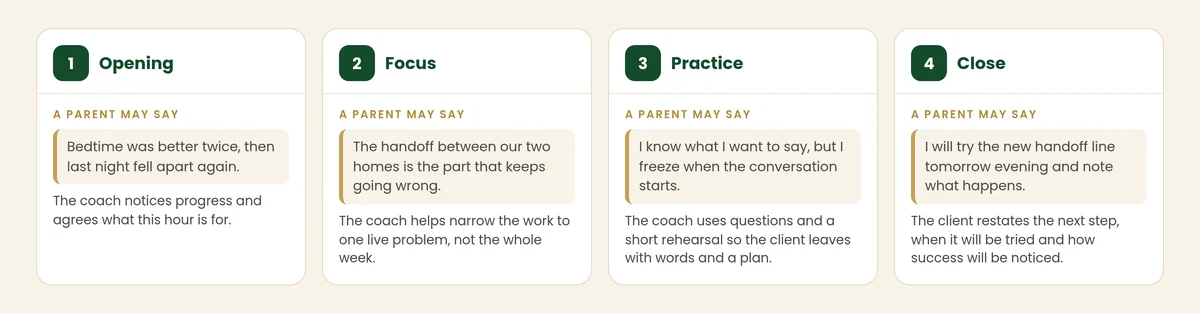
A useful session has a clear shape, so the hour does not turn into a long vent or a lecture. The coach opens with what has changed since the last meeting, agrees a focus for the call, helps the client think through one live problem and leaves the client with a small practice to try at home.
The details vary, but most strong sessions touch the same four parts.
The session map below shows how a coaching call is built, from the opening check-in to the small practice the client takes home.
Parenting coaching sits close to two other kinds of help, and the overlap confuses new coaches and clients alike. Getting the difference clear protects everyone and makes a parenting coach certification more useful, because the training should teach the boundary as well as the skill.
Therapy is clinical care. A licensed therapist assesses and treats mental health conditions, trauma and other clinical concerns. Coaching is a forward-looking partnership. It helps a capable client make changes in daily life. A coach does not diagnose a child or a parent, does not treat depression or anxiety and does not act as a family's therapist under a coaching title.
Parent education is also different. A parent educator teaches information, classes and skills, often to a group, with a set curriculum. A coach may share a short piece of information, then returns quickly to the client's own goal and the next action. Many good practitioners can do both, but they should know which hat is on.
The table below keeps the three roles easy to compare.
| Feature | Parenting Coaching | Parent Education | Therapy |
|---|---|---|---|
| Main aim | Help the client set goals and change daily habits at home | Teach parenting knowledge and skills, often in a class or workshop | Assess and treat mental health or other clinical concerns |
| Who it is for | Parents and caregivers who can take part in a planned, forward-looking process | Individuals or groups who want information and skill practice | People who need clinical care for mental health, trauma or diagnosis |
| Typical method | Questions, reflection, rehearsal and accountability between sessions | Lessons, activities and prepared materials | Clinical assessment, treatment planning and licensed therapy methods |
| Who leads decisions | The client | The educator sets the lesson, and the learner applies it | The clinician holds a treatment role, with the client taking part in care |
| Limit | Not diagnosis, not treatment and not a legal service | Not a substitute for coaching follow-through or for therapy | Not the same as coaching, even when a session includes parent guidance |
A person who already holds a therapy license may also offer parenting coaching, but the two services should not be blurred in marketing or in the room. When a coaching client needs clinical care, the right move is a referral, not a stretch of the coaching role.
A parenting coach certification is not a legal requirement in most places. Coaching is not licensed in the same way as therapy, counseling or social work, and the word certified is not a protected title for coaches. Someone can start coaching parents without a certificate. That is the honest legal picture, not a reason to skip training.
Certification still has a real job. It can give structure, observed practice and a shared language for ethics. Some schools, clinics and community groups ask about training before they refer families. People who want an individual credential from the International Coaching Federation also need coach-specific education hours, mentoring and documented experience, which a well-chosen program can supply.
The harder question is quality. One program may last a year and include a large supervised practicum. Another may be a short self-paced course with a quiz and a downloadable certificate. Both can use the same words on a sales page. A certificate only means the person finished that provider's program. It does not, on its own, prove skill with families.
A closer look at whether a coaching certification is required helps place parenting credentials in the wider coaching field.
Training remains wise even when the law does not demand a certificate. Parents trust a coach with private family life. Weak questions, leftover advice from one personal experience or a missed safety issue can cause harm. A serious program reduces that risk. A printed certificate with almost no practice does not.
Strong parenting coach training builds two kinds of competence at once. One is coaching skill, such as listening, powerful questions, agreements and follow-through. The other is enough knowledge of family life and child development to stay useful and stay in scope. Programs that lean only on content tend to produce lecturers. Programs that skip family knowledge can leave a new coach unprepared for what parents actually bring.
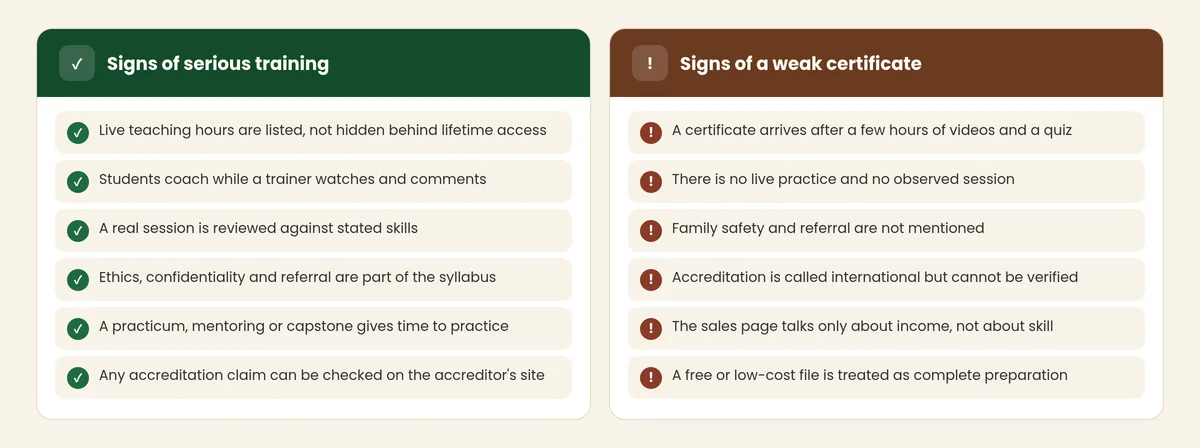
Before enrolling, it helps to ask a provider to show these parts in writing.
A free parenting coach certification can be a short introduction, but it is rarely a complete preparation for paid work with families. The same is true of any paid course that offers a certificate after a few hours and a quiz. Price is not the test. Practice, feedback and ethics are.
The comparison card below makes the difference easier to see without reading a long sales page.
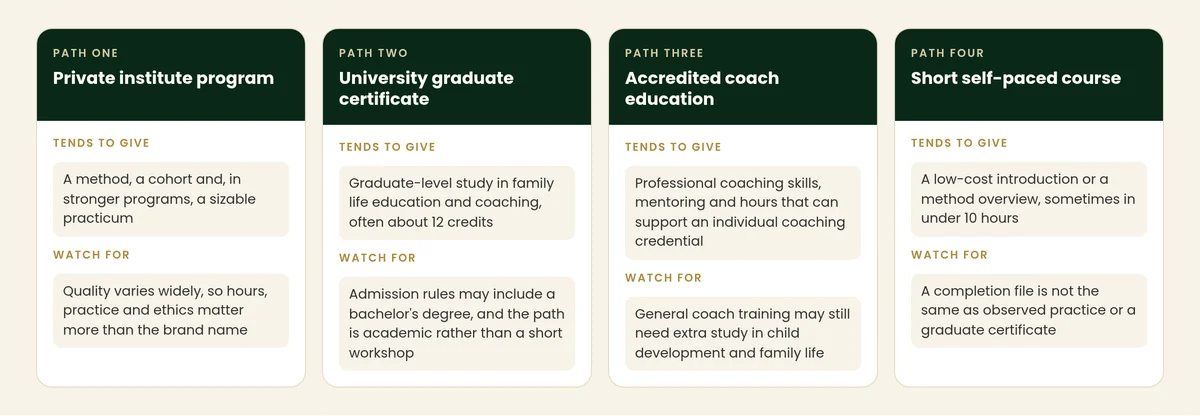
There is no single official school for this work, so people choose among four common paths. Each can be done online in many cases. The right fit depends on background, budget, time and whether an individual coaching credential is a later goal.
A private institute program is the path most people mean when they search for parenting coach certification. These providers teach a method, run a cohort and often include a practicum. The better ones last many months and ask for a large number of practice hours. They can be excellent or thin, so the checklist in the previous section matters more than the brand name on the certificate.
A university graduate certificate sits in a different category. North Carolina State University, for example, offers an online Graduate Certificate in Family Life Education and Coaching. It is a 12-credit graduate program that prepares students to work with families as family life educators and as family life coaches. Family life coaching is described there as a thought-provoking process that helps clients reach goals, while family life education focuses on preventive teaching.
Official details, courses and admission rules are on the NC State graduate certificate page.
ICF-accredited coach education is a third path. It trains the person as a professional coach first, using the International Coaching Federation's education standards. The entry-level individual credential, Associate Certified Coach, requires 60 hours of coaching education, 100 hours of coaching experience with at least 75 paid hours, 10 hours of mentor coaching over three months, a performance evaluation and a passing score on the ACC exam. This path is a strong base. It may still need extra study in child development and family life, because a general coaching program does not automatically teach parenting work.
A short self-paced course is the fourth path. Some of these last under 10 hours and end with a certificate of completion. They can be a low-cost way to learn a method or to test interest. They are not a substitute for observed practice, mentoring or a graduate certificate. Anyone comparing parent coaching certification online should read the syllabus before treating the certificate as proof of readiness.
The table below compares the four paths in one place.
| Path | What It Offers | What to Watch For |
|---|---|---|
| Private institute program | A method, a cohort and, in stronger programs, a sizable practicum | Quality varies, so hours, practice and ethics matter more than the brand name |
| University graduate certificate | Graduate study in family life education and coaching, often about 12 credits | Admission rules may include a bachelor's degree |
| ICF-accredited coach education | Professional coaching skills and hours that can support an individual credential | Extra study in family life and child development may still be needed |
| Short self-paced course | A low-cost introduction, sometimes in under 10 hours | A completion file is not observed practice or a graduate certificate |
The four path cards below put those options side by side, including what each path tends to give and what it tends to leave out.
Becoming a parenting coach is a sequence of skill, knowledge, practice and clear limits, not a single purchase. The steps below work for people with a related professional background and for people who are new to paid helping work. Certification fits inside this path. It is not the whole path.
A parenting coach cannot be equally useful to every family on the first day. It helps to choose a starting focus, such as early years routines, school-age behavior, support for caregivers after a separation, or families raising a neurodivergent child. The focus should be honest about skill and scope. A new coach who has no training in a specialized area should not sell that specialty until the knowledge and supervision are in place.
The starting focus can widen later. Early clarity simply makes training choices and first conversations easier.
Coaching skill is the heart of the work. That includes listening without rushing to fix, asking questions that help the client think, making a clear agreement for the relationship and helping the client notice progress. It also includes staying out of a rescue role. The parent does the work at home. The coach does not take over the family.
These skills can be learned in a parenting-specific program or in a general coach-education program that meets professional standards. Either way, they have to be practiced, not only read.
A parenting coach needs enough knowledge to recognize typical development, common family stress and the edge of the coaching role. This is not the same as becoming a child psychologist. It is enough learning to ask better questions, avoid harmful advice and know when another professional should join the picture.
Useful study includes stages of childhood, family communication, the difference between a difficult phase and a possible clinical concern, and the variety of family structures. Personal experience as a parent can inform empathy. It is not a complete training on its own, because clients will not have the same children, culture, values or constraints.
This is the point to choose a path and finish it with real attention. The best program is the one that matches the starting focus, includes observed practice and can be verified if it claims accreditation. People who already hold a coaching credential may need a shorter parenting specialty course. People who are new to coaching usually need a fuller program.
Online study can be a good format when it still includes live practice and feedback. Parent coaching certification online is only as strong as those practice hours.
Before paid clients arrive, the coach should write down what the work includes, what it excludes and who will be called if a safety issue appears. A simple client agreement should cover session length, fees, cancellation, confidentiality and its limits, and the fact that coaching is not therapy.
The International Coaching Federation publishes a public Code of Ethics that many professional coaches use as a baseline for agreements, confidentiality and professional conduct.
A referral plan is part of that same preparation. It should include local or telehealth therapy options, a plan for child-safety concerns and a calm way to pause coaching when coaching is no longer the right help.
The last step is supervised practice, then paid work. Early sessions can be offered at a reduced fee or as a short foundation series, with clear consent and a request for honest feedback. Mentoring or peer supervision helps catch blind spots that a new coach cannot see alone.
Once the coach can run a clean session, keep notes, stay in scope and ask for a referral when needed, it is reasonable to begin charging a full fee and talking publicly about the service. Finding those first clients is covered later in this blog, because the offer has to be clear before outreach begins.
Searches for how much parenting coaches make run into a simple problem. The US Bureau of Labor Statistics does not publish a wage for parenting coaches, and it does not treat life coaching as its own occupation either. So there is no official salary to quote for this title.
Most parenting coaches are paid in one of two ways. Some are employees of a practice, school, nonprofit or health setting, and they earn a wage set by that employer. Others work independently and earn client fees minus the costs of running a practice, such as training, insurance, software and unpaid admin time. Those two numbers are not the same thing, and a website average that mixes them can mislead.
The best public data on coaching income is still general, not parenting-specific. In the International Coaching Federation Global Coaching Study, coach practitioners worldwide reported an average annual revenue of $49,283 from coaching activities. The same study reported an average fee of $234 for a one-hour session, an average of 11.6 hours a week spent working as a coach and an average of 12.4 active clients. The figures come from a large self-reported survey of coaches as a whole, and they describe revenue from coaching, not take-home pay.
The public summary is on the ICF Global Coaching Study page.
Those averages also hide a wide spread. Many coaches work far fewer than full-time hours. People in their first year often earn less, while coaches with a full caseload, a specialized offer or organizational clients may earn more. A parenting coach who charges only for one-to-one sessions will have a different income from a coach who also runs groups, teaches workshops or is employed by an agency.
The table below keeps the main figures in context, so a headline number is not mistaken for a salary.
| Figure | What It Describes | What It Does Not Mean |
|---|---|---|
| Official US wage for parenting coaches | The Bureau of Labor Statistics does not publish one | A salary quoted online is not a government wage for this title |
| ICF average of $49,283 a year | Self-reported annual coaching revenue among coach practitioners worldwide | A parenting-specific salary, a full-time wage or take-home pay |
| ICF average of 11.6 coaching hours a week | Typical time spent working as a coach in that survey | A 40-hour work week or a guaranteed caseload |
| ICF average fee of $234 for one hour | A global average session fee among surveyed coaches | The fee every new parenting coach can charge |
A realistic plan starts with hours, fee and costs, not with a headline salary. If a coach works 10 coaching hours a week for 45 weeks at a given fee, that is the gross revenue before expenses and tax. If the same person is hired as a staff coach, the wage is whatever the role pays in that place. Either way, income grows when the coach keeps clients through a clear program, not when a certificate is framed as a guarantee of high pay.
First clients usually come from conversations, not from a logo on a certificate. The coach needs a plain offer, such as a six-session series on calmer evenings or a program for caregivers who are building new routines after a family change. People should be able to tell who the work is for, what will happen and what sits outside the scope.
A practical walkthrough of how to get coaching clients covers outreach that also works for parenting coaches.
Local and online channels that tend to fit this specialty include the following.
Referrals work better when other professionals trust the coach to stay in role. That is another reason the agreement and referral plan should be written before outreach scales up. A first workshop or a small set of foundation clients is enough to begin. Testimonials, if they are used, should be given freely and should never identify a child.
The most important skill in this field may be knowing when to stop. Parents often arrive in distress, and distress can hide a problem that coaching cannot handle. A parenting coach can be warm and still hold a firm line.
Coaching can continue when the client is able to take part, set goals and try new actions, and when the main need is support with parenting habits, communication and daily structure. Coaching can sometimes run alongside therapy when a clinician is already involved and the client wants practical help at home. Coaching should pause, and a referral should come first, when any of the following appear.
The three-column guide below can sit beside a coach's agreement, so the referral line is decided before a difficult session begins.
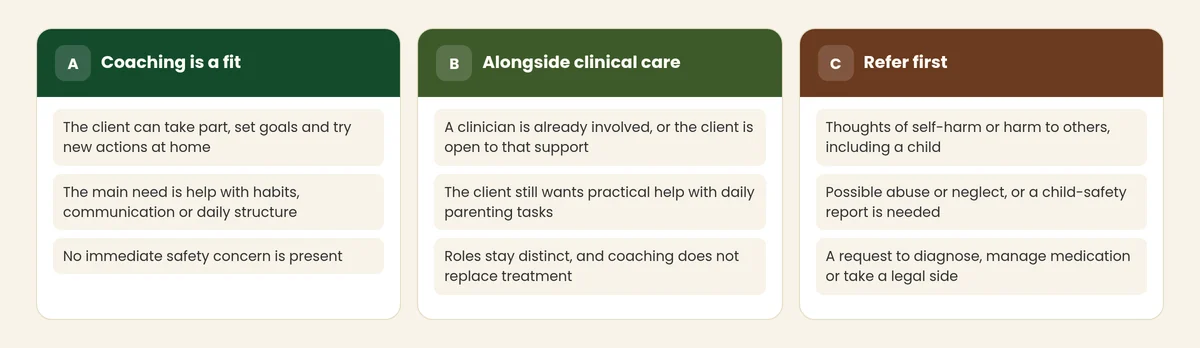
Raising a referral is part of the work, not a failure of it. The coach can name what has been heard, explain that coaching is the wrong tool for that concern and help the client take the next step toward the right kind of care. If a child may be at risk, the coach follows the law and the written safety plan, even if that is a hard conversation.
A parenting coach certification can be a useful part of professional preparation, especially when the program includes practice, feedback and ethics. It is not a license, not a promise of a high salary and not a substitute for judgment in the room.
The coaches who do this work well keep the role small and clear. They help parents and caregivers make ordinary days more workable. They keep studying. They refer quickly when the need is clinical or a safety issue. That mix of skill and restraint is what families actually need.
Coaches who are ready to offer sessions can apply to join a coaching marketplace.
What is a parenting coach?
A parenting coach is a professional who helps parents and other caregivers set goals, practice new habits and handle daily family challenges. The coach works with the adult, not as the child's therapist. Sessions are planned and forward-looking, and the client stays in charge of decisions at home.
Do you need a certification to be a parenting coach?
No. A parenting coach certification is not a government license, and coaching is not regulated like therapy in most places. Serious training is still wise, because families share private struggles and expect a competent, ethical coach. A certificate is valuable when it includes practice and feedback, not when it is only a file to download.
How long does it take to become a parenting coach?
The time depends on the path. A short self-paced course can last under 10 hours. A fuller private program may take many months and include a large practicum. A university graduate certificate may involve 12 credits of study. Building enough skill to work with paying clients usually takes longer than the shortest certificate alone.
How much do parenting coaches make?
There is no official government wage for parenting coaches. Independent coaches earn client fees minus costs, while employed coaches earn a wage from an organization. The International Coaching Federation Global Coaching Study reports a global average coaching revenue of $49,283 a year for coach practitioners in general, with about 11.6 coaching hours a week. That figure is not a parenting-specific salary and is not take-home pay.
What is the difference between a parenting coach and a therapist?
A parenting coach helps a client change daily parenting habits and communication. A therapist is a licensed clinician who assesses and treats mental health conditions and other clinical concerns. Coaching is not therapy, even when a session is emotional. If a parent or child needs clinical care, the coach refers rather than stretching the role.
Can someone become a parenting coach without a degree?
Yes, in most cases a university degree is not a legal requirement to coach parents. Some university certificate programs do ask for a bachelor's degree, and some employers may prefer a related degree. Skill, supervised practice and a clear scope matter more than a diploma on its own. People without a degree can still complete a serious private training program.
Is parenting coach certification available online?
Yes. Many private programs, some university graduate certificates and many ICF-accredited coach education courses can be completed online. Online study is strongest when it still includes live practice, observed sessions and feedback. A short self-paced course can be a start, but a certificate earned only from videos and a quiz is rarely enough preparation for paid work.

