

Contact us
A simple guide to writing a dating profile bio that sounds like you, with 10 techniques, before and after examples, sample bios and common mistakes to avoid.
To write a good dating profile bio, describe your personality, interests, lifestyle and relationship intentions in a way that gives potential matches a genuine reason to connect with you. Use specific details instead of generic descriptions, keep your writing conversational, and include something that makes starting a conversation easier.
But how do you fit your personality into a few sentences without sounding boring, predictable or overly rehearsed?
Whether you are creating a dating profile for the first time or rewriting one that is not getting the attention you hoped for, the right approach can make a difference.
Read on to discover 10 practical ways to write a dating profile bio that feels authentic and gives compatible people a reason to match.
A good dating profile bio combines personal details, authentic self-expression and clear communication. Rather than listing attractive qualities, it should help someone understand what spending time with you might actually feel like.
| What to include | Why it matters |
|---|---|
| A personality-driven opening | Gives readers an immediate impression of who you are. |
| Specific interests and hobbies | Makes your profile more memorable and relatable. |
| Everyday lifestyle details | Helps potential matches imagine shared experiences. |
| Natural humour | Adds warmth and makes your personality more approachable. |
| Personal values | Communicate what matters to you beyond appearances. |
| Relationship intentions | Helps attract people looking for a similar connection. |
| Conversation starters | Gives potential matches an easy reason to message you. |
| Concise writing | Makes your bio easier to read and remember. |
| Authentic language | Makes your profile feel personal rather than copied. |
| A natural closing line | Creates an opportunity for further conversation. |
The key takeaway: Your bio should not read like a list of qualifications. It should feel like a small introduction to the person someone might get to know.
A memorable dating bio does not necessarily need clever one-liners or elaborate descriptions. What matters is how effectively it communicates your personality and gives someone something meaningful to connect with. These ten writing techniques can help you create a more engaging profile.
The opening line sets the tone for the rest of your dating profile. If it begins with something like "I am a fun-loving, adventurous and caring person," it tells people what you want them to think about you without showing much about who you actually are.
Instead, start with a detail that reflects your personality, interests or everyday habits.
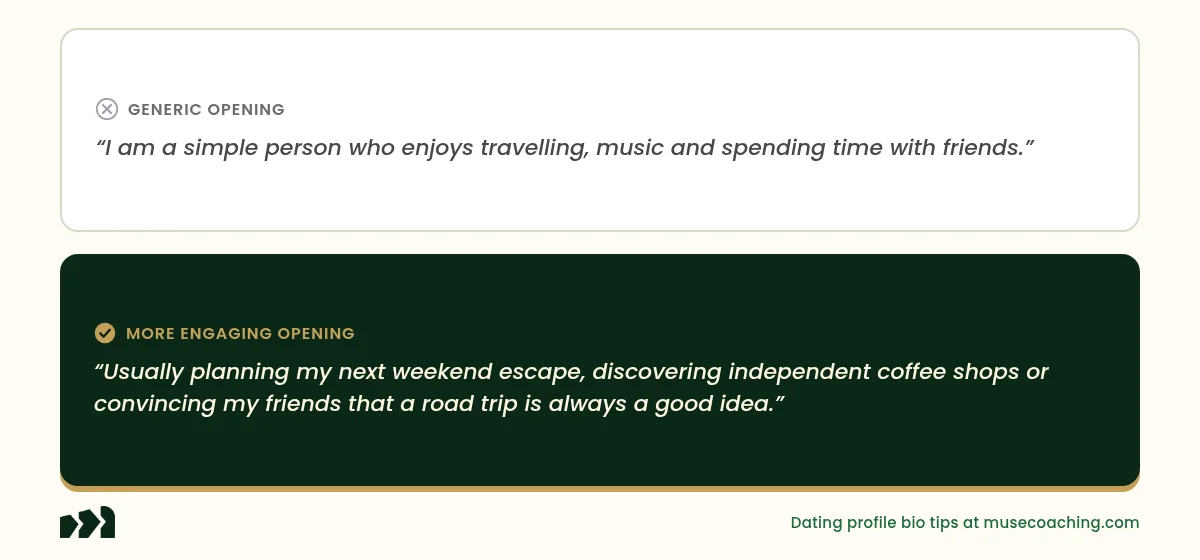
The second introduction gives someone a clearer picture of your personality. It also creates natural conversation opportunities.
Think about the details that people who know you would immediately associate with you. Maybe you are always discovering new restaurants, enjoy quiet weekends with a book or are the person who organizes spontaneous plans. These details can make a stronger introduction than a collection of personality adjectives.
Mentioning hobbies is useful, but simply listing them does not tell potential matches much about your personality.
For example, thousands of people enjoy travelling, watching movies, listening to music and trying new food. Those interests are perfectly valid, but the way you describe them can make your profile more distinctive.
Consider the difference:
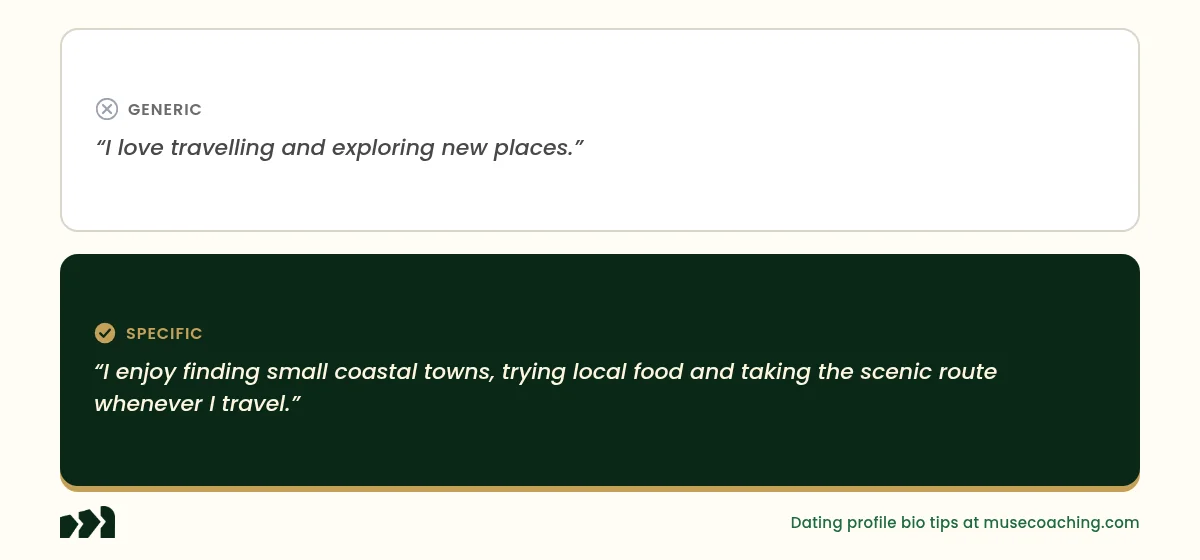
Both descriptions communicate an interest in travelling. However, the second gives readers something more concrete to imagine and potentially discuss.
When writing about your interests, consider including:
You do not need to include every hobby. Choose two or three that genuinely represent your lifestyle and give people a better understanding of who you are.
People often describe themselves using words such as ambitious, adventurous, thoughtful or spontaneous. However, these descriptions become more meaningful when supported by examples of everyday life.
Instead of telling someone that you are adventurous, describe the kind of activities you enjoy. Rather than calling yourself thoughtful, mention how you like remembering small details or making time for people you care about.
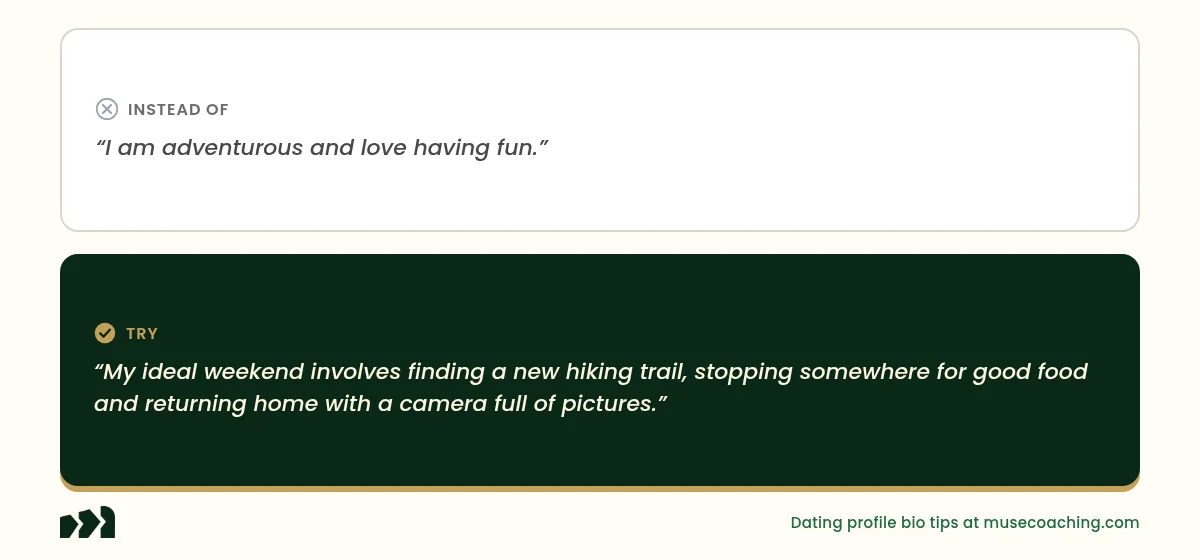
This approach helps potential matches imagine the experiences you enjoy. It also gives them opportunities to identify shared interests.
Your bio does not need to describe an exciting lifestyle every day. Ordinary details can be just as interesting when they genuinely reflect your personality. Someone who enjoys peaceful evenings, cooking at home or exploring local bookstores should not feel pressured to present themselves as constantly travelling or seeking adventure.
Humour can make a dating profile feel relaxed and approachable, but trying too hard to be funny can make the writing feel unnatural.
You do not need an elaborate joke or a clever pickup line. Sometimes, a light observation about your habits or preferences is enough to communicate your sense of humour.
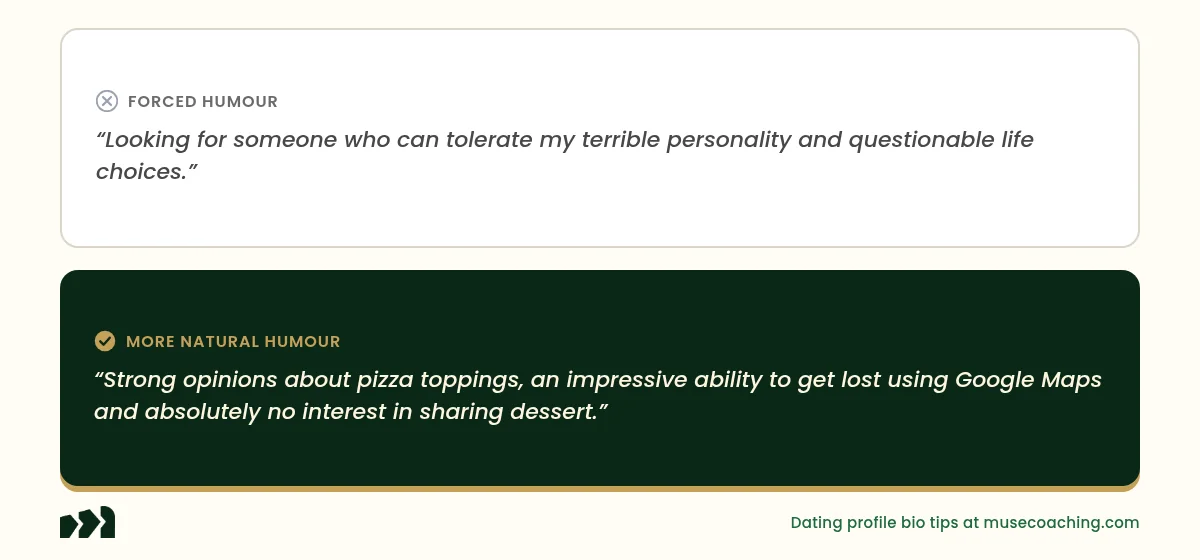
The second example introduces humour without making the person sound overly negative.
A few ways to include humour naturally:
Most importantly, do not adopt a humorous personality just because you think dating apps reward it. Your profile should sound like someone a potential match could comfortably have a conversation with.
A dating profile bio should communicate more than your favourite activities. It can also give people an understanding of what matters to you and what kind of connection you hope to build.
However, directly listing qualities such as honesty, loyalty, kindness and emotional maturity can make your bio sound like a checklist.
Instead, demonstrate those values through your preferences and experiences.
For example:
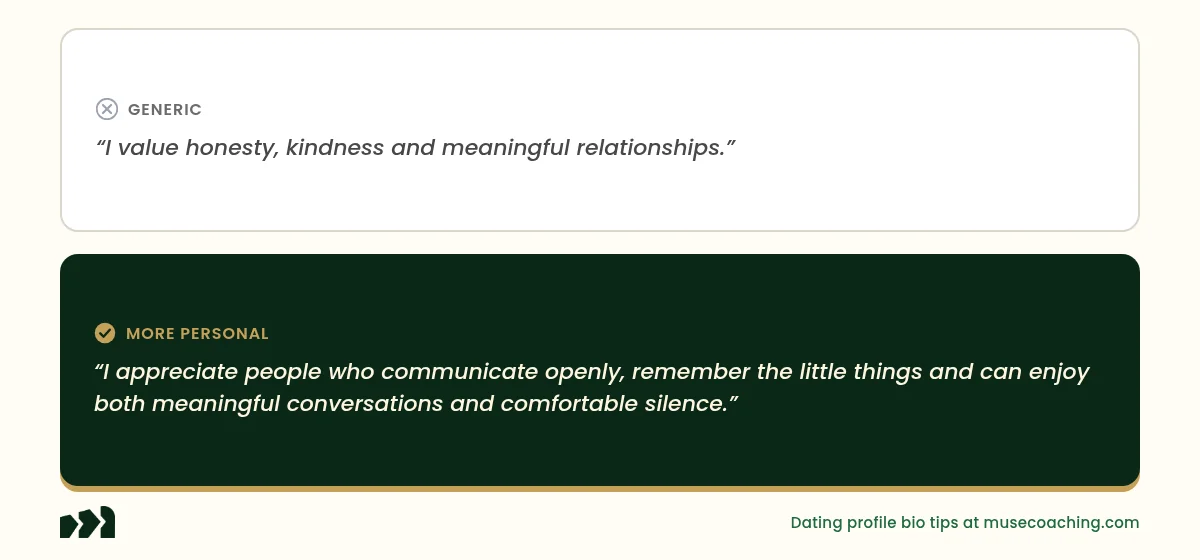
The improved version communicates similar values but feels more conversational.
You can reflect your values through details such as:
Your personal circumstances and responsibilities can also influence what you value in a relationship.
For example, single parents may want to communicate the importance of family, parenting commitments and finding someone who respects their lifestyle. You do not need to explain every detail in your dating bio, but sharing what matters to you can help potential matches understand your priorities.
If you are navigating relationships while raising a child, dating as a single parent offers further insight into some of the considerations involved.
The intention is not to write an extensive description of your personal philosophy. A few thoughtful details are enough to help someone understand what kind of connection you value.
One of the most useful things a dating profile can communicate is relationship intention.
Some people are interested in a long-term relationship, while others want to date casually, meet new people or explore connections without rushing into commitments. There is no single correct preference, but being reasonably clear can help avoid mismatched expectations.
For example:
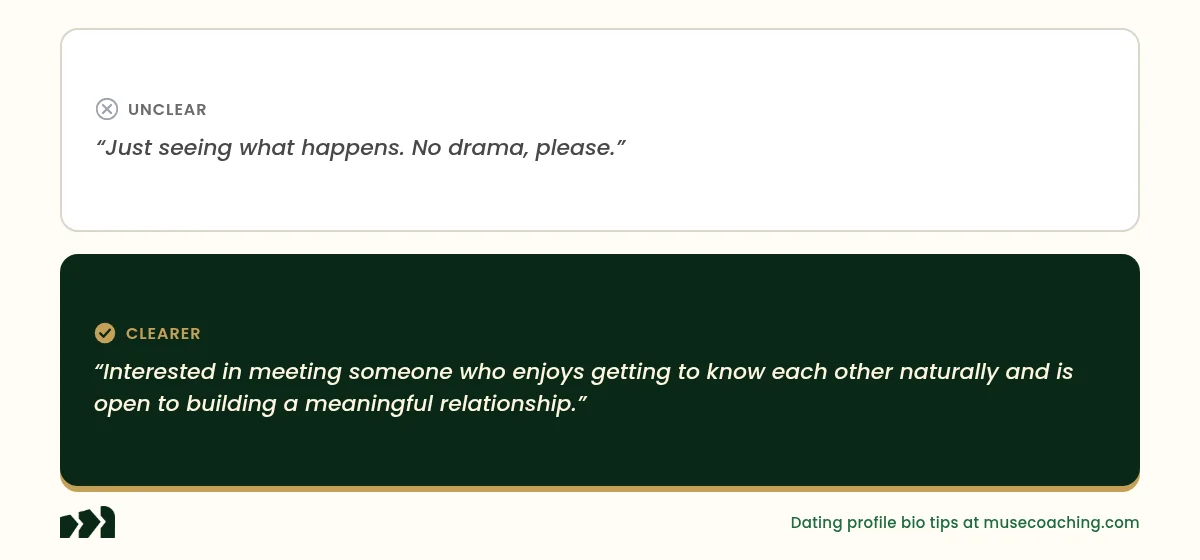
The second version communicates an intention without placing unnecessary pressure on a potential match.
When describing what you are looking for, consider:
Avoid turning your bio into a list of demands. Statements such as "must be ambitious," "no boring people" or "only message if you are serious" can create an unnecessarily negative first impression.
You can communicate your preferences without making potential matches feel as though they are applying for an interview.
One reason some dating profiles struggle to start conversations is that they provide very little information to respond to.
Consider a bio that simply says:
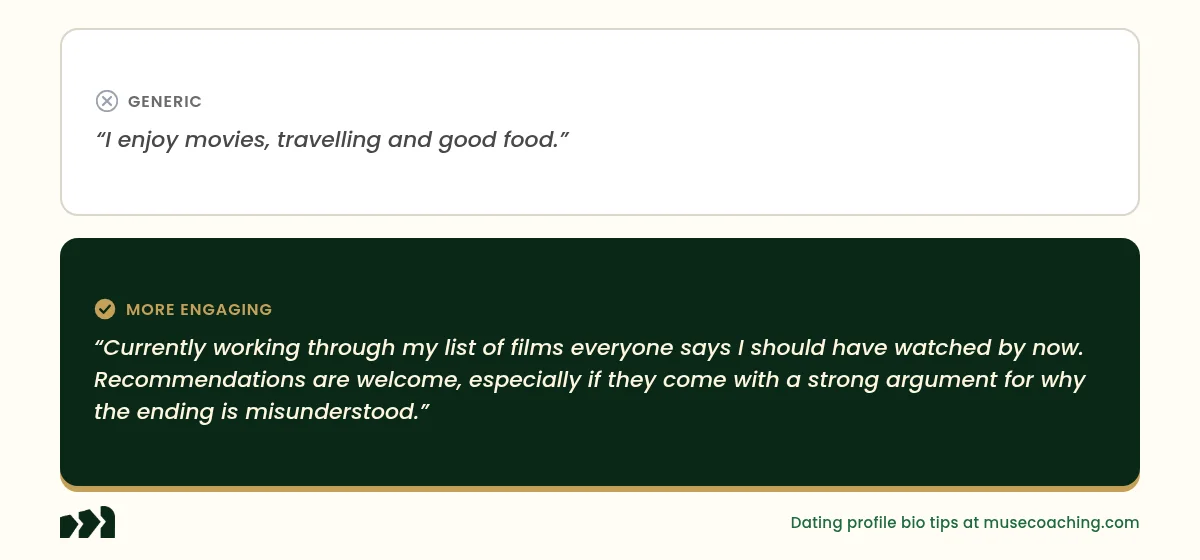
Someone might share those interests, but there is no obvious direction for the conversation.
This gives someone an easy opening message.
A good conversation hook can be:
The objective is to make interaction easier, not to create a complicated question that people feel obligated to answer.
A specific detail often works better than a generic invitation such as "Ask me anything."
A dating profile bio is not a personal autobiography. You do not need to explain your entire background, career history, personality or relationship experiences in a few paragraphs.
Too much information can make your introduction difficult to follow. On the other hand, an extremely short bio may leave potential matches with little understanding of who you are.
A useful approach is to prioritize a few meaningful details:
For example:
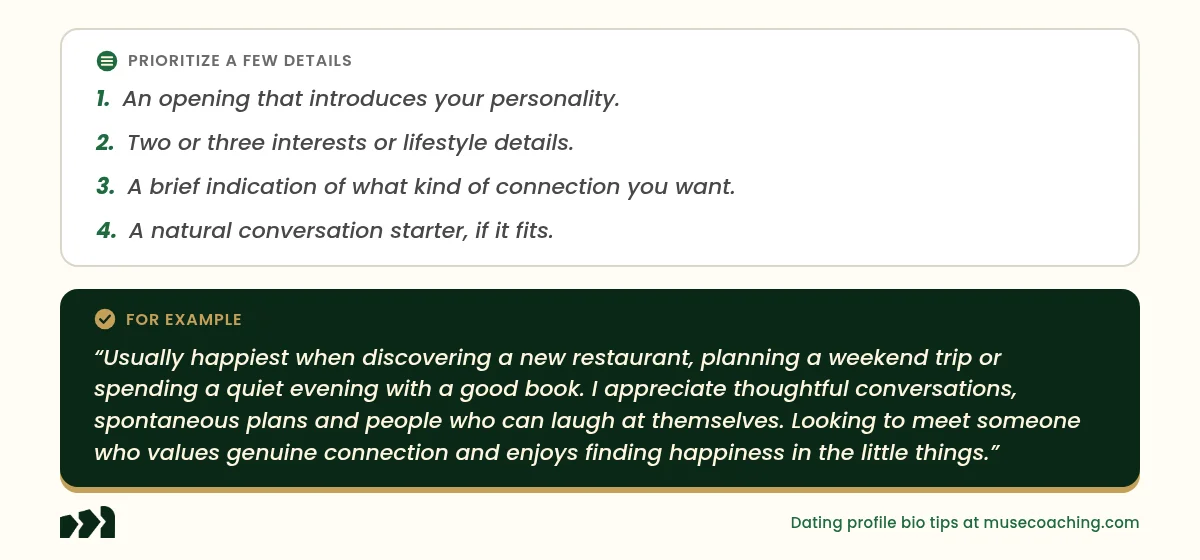
This provides a reasonable introduction without overwhelming the reader.
There is no universal word count that guarantees a successful bio. The appropriate length depends on the dating app, its profile format and how much information you need to communicate. Prioritize clarity over filling every available character.
One of the biggest problems with online dating bios is that people often borrow phrases from other profiles or copy examples without considering whether they reflect their actual personality.
Expressions such as "looking for my partner in crime," "fluent in sarcasm" and "love adventures" are not necessarily bad. However, they become forgettable when they are used without personal context.
A better approach is to think about how you naturally describe yourself when meeting someone in person.
Ask yourself:
For instance, if you enjoy spending your weekends cooking, you do not need to describe yourself as a passionate culinary explorer. You could simply write:
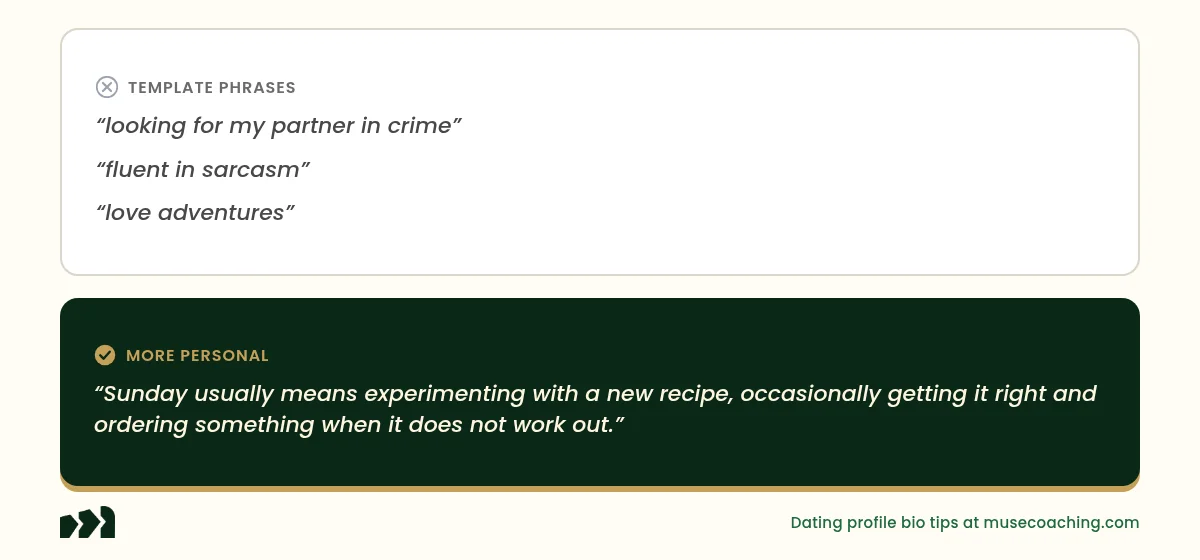
That sounds more personal because it describes an actual experience rather than trying to create an impressive identity.
Authenticity does not mean sharing everything about yourself. It means presenting yourself honestly and choosing details that represent the person you are.
A strong closing line gives someone an easy way to move from reading your profile to starting a conversation.
Instead of finishing with "Feel free to message me," introduce a topic that invites a response.
For example:
These questions are simple, but they give people something specific to respond to.
You can also make the closing line more personal by connecting it to something already mentioned in your bio.
For example, someone who enjoys travelling might write:
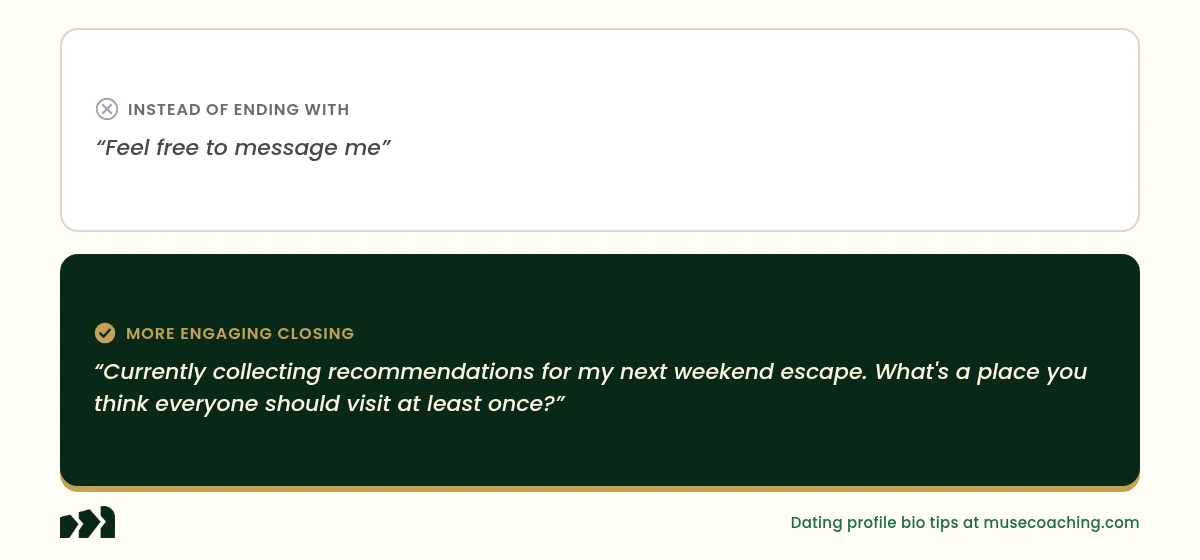
This creates a natural continuation of the introduction rather than adding a random question at the end.
Remember that a conversation starter should reflect your actual interests. The best opening is one you would genuinely enjoy discussing after someone responds.
Understanding writing techniques is useful, but seeing how they come together in a complete bio makes the process easier. The following examples demonstrate different personalities, lifestyles and relationship intentions. They are starting points to adapt rather than templates to copy word for word.
"Usually spending my free time discovering new cafes, watching a good series or finding excuses to take a weekend trip. I enjoy easygoing conversations, spontaneous plans and people who do not take themselves too seriously. Always interested in a good food recommendation."
Why it works: It communicates everyday interests, a relaxed personality and an easy conversation opportunity without trying too hard.
"Part-time overthinker, full-time dessert enthusiast. I can spend an unreasonable amount of time choosing what to watch and still end up rewatching something familiar. Looking for someone who enjoys good conversations, spontaneous outings and sharing the last slice of cake."
Why it works: The humour comes from relatable habits rather than exaggerated claims. It also communicates the person's interests and conversational style.
"I value meaningful conversations, emotional maturity and the kind of connection where both people can be completely themselves. I enjoy travelling, quiet evenings and spending quality time with people who matter. Hoping to meet someone interested in building something genuine at a comfortable pace."
Why it works: It communicates relationship intentions and personal values without sounding overly demanding or treating dating like a checklist.
"Coffee enthusiast, weekend explorer and someone who believes the best conversations rarely follow a script. Looking for genuine connections and good company."
Why it works: It is concise while still communicating interests, personality and relationship openness.
"Most weekends involve a new recipe, a long walk or searching for a bookstore I have not visited before. I enjoy learning new things, discovering interesting places and having conversations that go beyond small talk. Always happy to exchange book recommendations."
Why it works: It uses specific lifestyle details to make the person easier to imagine and gives potential matches a natural conversation topic.
Even when someone has interesting hobbies, positive intentions and a good sense of humour, certain writing choices can make their profile less effective. Reviewing these common mistakes can help you identify areas that need improvement.
| Mistake | Why it can be ineffective | Better approach |
|---|---|---|
| Using generic descriptions | Does not communicate much individuality. | Replace broad claims with specific experiences. |
| Listing too many hobbies | Makes the bio feel like a checklist. | Highlight a few meaningful interests. |
| Sounding negative | Can create an unnecessarily unwelcoming first impression. | Focus on what you appreciate and want. |
| Writing a long autobiography | Makes the main message difficult to identify. | Prioritize the most relevant personal details. |
| Copying popular bios | Can make your profile sound impersonal. | Use your own experiences and natural language. |
| Making unrealistic claims | Can create expectations that do not reflect everyday life. | Present yourself honestly. |
| Listing demands | Can make potential matches feel judged before a conversation begins. | Communicate preferences respectfully. |
| Leaving out relationship intentions | May create confusion about what you want. | State your preferences clearly and naturally. |
A useful final test is to read your bio as if you were someone who had never met you. Would it give you an understanding of the person's personality? Would it help you think of something to ask? Does it communicate what kind of connection they want?
If the answer to these questions is unclear, the bio probably needs another round of editing.
Sometimes, knowing the basic rules of dating profile writing is not enough. You might understand that your bio needs personality, specific details and a clear introduction, but still struggle to translate those ideas into something that feels natural.
This is where hiring a dating profile coach can be helpful.
A dating profile coach provides an outside perspective on how your profile comes across to potential matches. Instead of relying on generic templates or repeatedly changing individual sentences, you can get personalized feedback based on your personality, preferences and relationship goals.
Professional guidance may be particularly useful when:
Sometimes, the challenge also involves more than the profile itself. You may be uncertain about your relationship expectations, struggling with dating confidence or trying to understand what you want from a new connection.
In these situations, dating coaching can provide broader support with relationship goals, dating confidence and building meaningful connections.
A coach cannot guarantee matches or determine who will be interested in you. However, personalized feedback can help you identify unclear messaging, communicate your personality more effectively and create a profile that better represents what you are looking for.
A professional dating profile coach looks beyond individual sentences. The aim is to understand how the entire profile communicates a person's personality, lifestyle and relationship intentions.
Depending on the service, coaching may include:
The value of professional coaching is not simply having someone write a few attractive sentences. It is receiving guidance that considers the person behind the profile.
A dating profile should communicate something meaningful about you, not present an artificial version of yourself designed to appeal to as many people as possible.
This can be difficult when you are too close to your own profile. You might overlook information that makes you interesting, struggle to identify which details deserve attention or unintentionally use language that sounds different from your real personality.
Working with a dating profile coach can help bring a different perspective to the process. Rather than simply replacing your existing sentences, personalized guidance can help identify what your profile currently communicates, what may be missing and how to express your personality more clearly.
At Muse Coaching, personalized dating profile coaching focuses on helping people present themselves more authentically and thoughtfully.
From improving your bio and selecting relevant profile details to refining dating app prompts and reviewing your overall presentation, professional guidance can help you approach online dating with greater clarity.
Your profile does not need to impress everyone. It needs to give the right people a genuine understanding of who you are and a reason to start getting to know you.
Writing a dating profile bio is an opportunity to introduce yourself in a way that feels genuine, communicates what matters to you and helps potential matches understand the person behind the photographs. The strongest profiles are not necessarily the funniest or most impressive. They are the ones that make personality, interests and relationship intentions clear without sounding forced or overly rehearsed.
If you find it difficult to describe yourself, repeatedly rewrite your bio without feeling satisfied, or struggle to understand how your profile comes across to others, getting professional guidance can offer a fresh perspective. A dating profile coach can help you identify what makes your introduction distinctive and express it more effectively.
Your bio does not need to appeal to everyone. It needs to represent you honestly and give someone compatible a genuine reason to connect.
Write about your personality, interests, everyday lifestyle and relationship intentions. Include specific details that help potential matches understand who you are instead of relying on generic descriptions. A natural conversation starter can also make it easier for someone to message you.
There is no universal ideal length. A dating bio should be long enough to communicate your personality, interests and intentions without becoming difficult to read. Consider the character limits and profile format of the dating app you are using, and prioritize relevant information over unnecessary details.
Use specific examples, natural humour and details about your everyday life. Instead of saying you love travelling, mention the kind of places you enjoy exploring or a memorable experience. Including a conversation starter can also give potential matches something to ask about.
Avoid excessive negativity, unrealistic claims, generic clichés, long lists of demands and copied descriptions. Do not turn your bio into a list of requirements for a potential partner. Focus on communicating your personality and preferences in a positive, honest and conversational way.
Yes, if you have a clear preference, communicating it can help potential matches understand your intentions. Whether you are interested in a serious relationship, casual dating or meeting people without rushing into commitments, express your preference naturally and respectfully.
You can use the same basic introduction across different dating apps, but adapting it to each platform is generally more useful. Hinge offers prompts that encourage more detailed self-expression, while Tinder and Bumble have their own profile formats and features. Adjust your content to make the best use of each platform.
Start with simple questions about your interests, daily routines, personality and relationship preferences. Ask trusted friends what they notice about you, or think about the experiences you genuinely enjoy. If you continue struggling, a dating profile coach can help you identify and communicate your strongest personal details.
Yes, a bio can contribute to how people understand and evaluate your profile. Photographs may influence initial impressions, but written information adds context about your personality, interests and relationship intentions. A thoughtful bio can help potential matches find common ground and decide whether they would like to start a conversation.