
A practical guide for coaches who want to specialize in burnout coaching, covering training, scope and referral, a six-session client plan, the signs to watch for and how to find your first clients.
Burnout coaching helps people recover from long-term work stress, and you become a burnout coach by building core coaching skills, learning how burnout develops, setting a clear referral line and running a short, structured program.
Burnout brings many people to coaching. They arrive tired, flat and unsure whether to stay in their job or walk away. They need someone to help them change what drains them without pretending to be their doctor.
This guide shows you how to train for the work, what happens in each session, where coaching stops and how to find your first clients.
Keep reading to find the one skill that sets great burnout coaches apart, and the mistake most new coaches make.
Burnout coaching is practical, people-focused work with clear limits. The table sums up the essentials before you read the full guide.
| Detail | What It Means |
|---|---|
| What it is | Coaching that helps clients recover from chronic work stress and change what causes it |
| What it is not | Therapy, diagnosis or medical treatment of any kind |
| Official status | The WHO lists burnout in ICD-11 as an occupational phenomenon rather than a medical condition |
| Three core signs | Exhaustion, mental distance from the job and lower effectiveness at work |
| Training | Coaching needs no license in most US states, but core coach training and burnout study make you safer and more credible |
| Evidence | Two physician trials found that six coaching sessions cut burnout compared with no coaching |
| Program length | Both trials used six sessions spread over three to five months |
| Referral line | Thoughts of self-harm, weeks of low mood or trouble with daily tasks mean the client needs clinical care first |
Burnout coaching is one-to-one or group coaching for people worn down by long-term work stress. The coach helps the client see what is draining them, change what they can at work and at home, and make clear decisions about their job. It looks forward and never diagnoses or treats illness.
Most people who look for burnout coaching still show up to work every day. They are not in crisis, but they feel empty, short-tempered and stuck. A burnout coach gives them structure, honest questions and steady accountability while they rebuild their energy.
The World Health Organization describes burnout in ICD-11 as the result of chronic workplace stress that has not been managed well. It is treated as an occupational phenomenon rather than a medical condition, and it applies only to work, not to other parts of life.
You can read the full WHO definition of burnout on the WHO website.
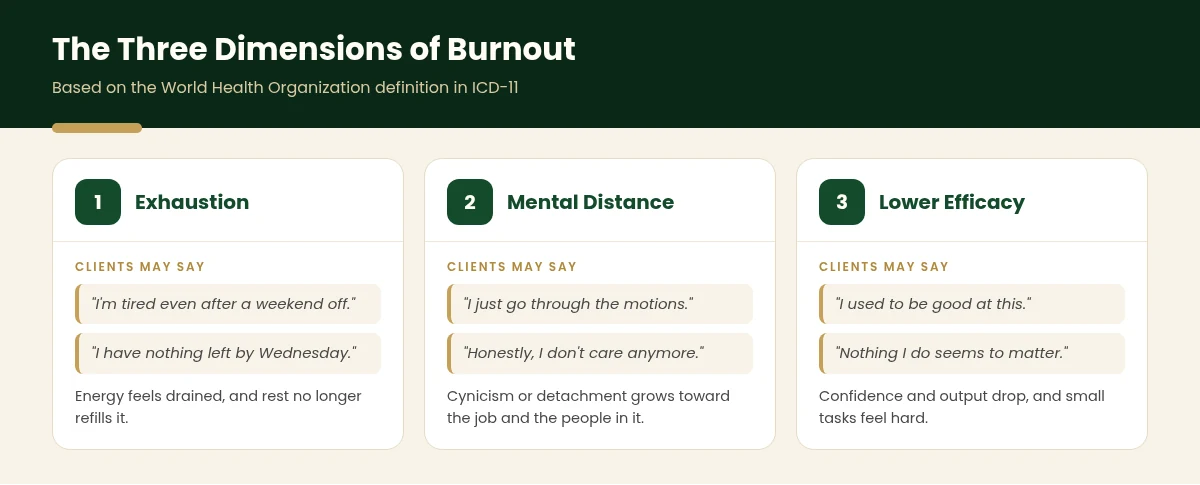
The definition names three dimensions, and together they give you a simple map for every first session.
Exhaustion: The client feels drained of energy, even after rest.
Mental distance: The client grows cynical, negative or detached from the job.
Lower efficacy: The client feels less able to do the work well.
The card below turns those three dimensions into the words clients tend to use, so you can match what you hear to the right one.
Burnout, stress and depression can look alike, and clients often mix them up. Knowing the difference helps you decide whether burnout coaching is the right support or whether a client needs a doctor first.
Stress usually feels like too much, with racing thoughts and a sense of urgency. Burnout feels more like too little, with low energy and less care about work.
Depression reaches every part of life, and it needs assessment by a doctor or a licensed mental health professional. Researchers also point out that burnout and depression overlap a lot, so when you are unsure, a medical check comes first.
| Feature | Everyday Stress | Burnout | Depression |
|---|---|---|---|
| Main feeling | Pressure and urgency | Emptiness and detachment from work | Low mood and loss of interest in most things |
| Where it shows up | Busy periods at work or home | Mainly in work and how the client sees their job | Across work, home, relationships and hobbies |
| Does rest help? | Usually, within days | Only a little, and the tiredness returns at work | Often not, and it may feel worse |
| Who helps most | Stress management coach, manager or good routines | Burnout coach, often alongside a doctor | Doctor or licensed therapist |
A burnout coach helps clients find the causes of their exhaustion, test small changes and plan bigger decisions. Sessions mix reflective questions, simple tracking between calls and practice for hard conversations. The coach does not diagnose, prescribe or tell the client to quit. The client stays in charge of every choice.
The work usually covers six areas, and most programs touch all of them.
You may hear clients mention the Maslach Burnout Inventory. It is a licensed research questionnaire, so do not treat an online quiz score as a burnout assessment or a diagnosis. A plain self-rating from 1 to 10 on energy, detachment and effectiveness is enough to track progress in coaching.
The strongest evidence for burnout coaching comes from trials with doctors, a group with high burnout rates and plenty of research behind it. The results are encouraging, though they do not prove that coaching works the same way in every job.
In a Mayo Clinic pilot trial of 88 physicians, six sessions with a professional coach cut rates of overall burnout by 17.1%. Burnout rose by 4.9% in the group without coaching.
See the full professional coaching trial for physician burnout for the methods and results.
A larger trial of 138 physicians tested peer coaching instead. Six sessions over three months with trained physician peers lowered overall burnout scores by 21.6%, compared with a 2.5% rise in the control group.
The results are published in this randomized trial of peer coaching for physicians in JAMA Network Open.
Two lessons from this physician burnout coaching research matter for your practice. Both trials used a short, fixed number of sessions, and both used coaches with formal training. That is a useful model for any burnout coaching program you design. Be honest with clients that results vary, and never promise a cure.
Burnout coaching suits coaches who stay calm around heavy emotion and enjoy practical problem solving. It is a harder fit for coaches who want fast, dramatic wins, because recovery is slow and uneven.
Check yourself against these signs of a good fit.
Lived experience helps, but it is not enough by itself. If you are still recovering from your own burnout, give yourself time before you coach others through theirs.
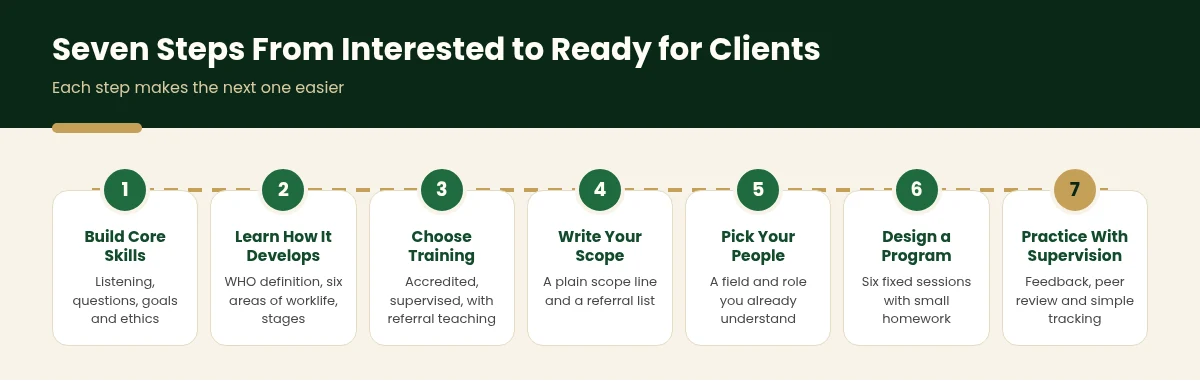
There is no single licensed route into this work. These seven steps give you the skills, safety and structure that clients expect from a burnout coach, in the order that makes each one easier.
The roadmap below shows the full path in one view, from core skills to your first supervised clients.
Burnout knowledge without coaching skill turns sessions into lectures. Good burnout coaching starts with the basics every coach needs, such as active listening, open questions, goal setting and ethical practice.
Programs accredited by the International Coaching Federation (ICF) teach these skills and include observed practice with feedback. If you are unsure whether you need a credential at all, weigh the options first.
Find out when life coach certification is worth the time and money.
Read the WHO definition, the six areas of worklife and the basic research on stress and recovery. Then learn the usual pattern, because clients rarely burn out overnight.
Many writers describe this pattern as the stages of burnout. It tends to start with long hours and high commitment, then moves to fading energy, growing cynicism and finally a sense of not coping. Knowing the pattern helps you see where a client sits and how much change they can handle right now.
A burnout coach certification is optional in most places, but it can help with employer contracts and teach you specialist tools. Programs range from short self-paced courses to year-long supervised training, so check these five things before you pay.
| What to Check | What Good Looks Like |
|---|---|
| Accreditation | The course is approved for ICF continuing education units |
| Supervised practice | You coach live and get feedback, rather than only watching videos |
| Referral training | The course teaches scope, risk and when to refer in plain detail |
| Evidence base | The content draws on published research, not on one founder's method |
| Trainer background | The trainers are coaches or clinicians with real burnout experience |
The JAMA peer coaching trial trained its coaches through Wellcoaches, a health and wellness coach program. That shows the value of structured training, not that any one brand is required.
Put your limits in writing before your first burnout coaching client books. A short scope line in your coaching agreement and on your profile protects clients and protects you.
For example, you might write "Coaching supports change at work and at home. It is not therapy or medical care." Then keep a list of referral options, including how clients reach a doctor, a licensed therapist and the 988 Suicide and Crisis Lifeline in the US. The section on where coaching ends, further down, covers the warning signs in detail.
"People who are burned out" is too wide a group to reach. Choose a group whose work you understand, so clients feel seen in your very first conversation.
Strong options include nurses, teachers, new managers, founders, working caregivers and remote workers who struggle to switch off. A workplace burnout coach who already knows a field's language and pressures earns trust much faster than a generalist does.
Clients with low energy do better with a clear, fixed plan than with open-ended sessions. Both physician trials used six sessions, which makes six a sensible starting length.
Decide how long each session runs, how many days sit between calls and what clients do between sessions. Keep homework small, since a tired client who fails at a big task often feels worse. The six-session plan later in this guide gives you a ready outline to adapt.
Coach a few practice clients before you charge, and ask for honest feedback after each session. Small fixes early on save you from bigger mistakes with paying clients.
Join a peer supervision group or work with a coaching supervisor so you can talk through hard cases. Track simple measures, such as a weekly energy score, so you can show progress without making medical claims.
Clients rarely open a first burnout coaching call by saying they are burned out. They describe tiredness, irritation or a job that suddenly feels pointless. Learning to hear the signs of burnout behind those words helps you choose the right first focus.
| Sign | What Clients Often Say | What You May Notice | Where Coaching Can Start |
|---|---|---|---|
| Exhaustion | "I sleep all weekend and still feel drained." | Slow replies, a flat voice, late or moved sessions | One protected break a day and basic recovery habits |
| Mental distance | "I just don't care about the work anymore." | Sarcasm about colleagues or customers, numbness | A values check on what used to matter and what changed |
| Lower efficacy | "I used to be good at this." | Harsh self-criticism, missed details, avoided tasks | Small wins and a workload reset with a manager |
| Physical strain | "I keep getting headaches and colds." | Frequent sick days and poor sleep | A doctor's visit before any deeper coaching work |
Burnout symptoms like poor sleep, headaches or frequent illness can also come from medical problems. Always encourage a client with physical symptoms to see a doctor, even when the cause looks obvious to them.
This is the most important skill in burnout recovery coaching. Burnout overlaps with depression, anxiety and physical illness, and a coach is not trained to tell them apart. Your job is to notice, say what you see and help the client reach the right professional.
The guide below sorts common situations into three groups, from safe coaching ground to an immediate referral.
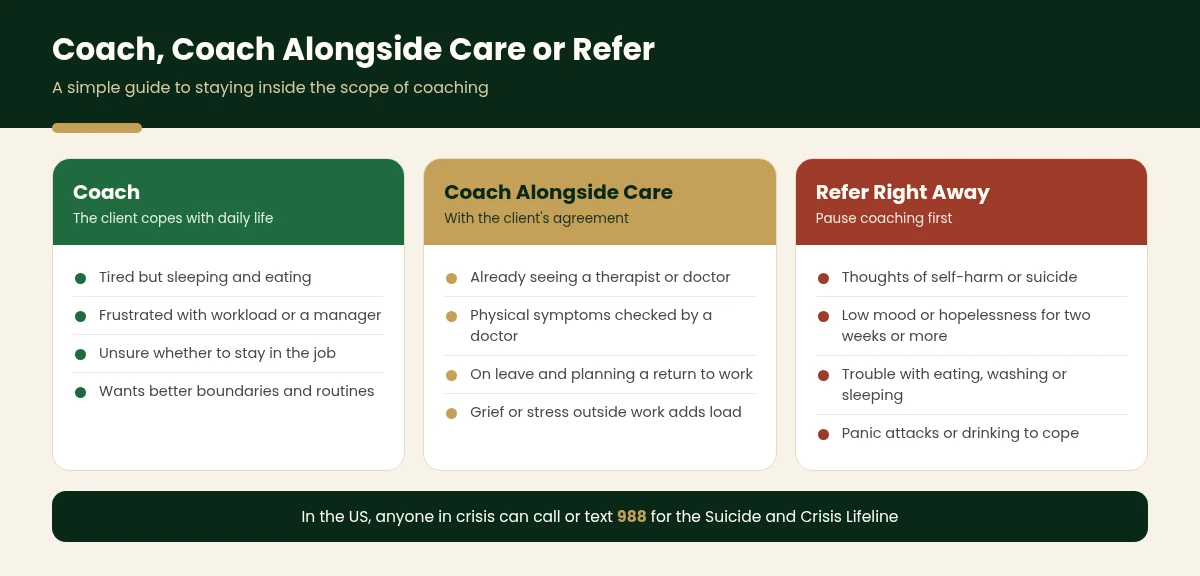
Refer a client to a doctor or a licensed therapist when any of these apply.
Coaching can often continue alongside therapy if the client wants it and their clinician agrees. In that case, keep your work on practical changes and leave diagnosis and treatment to the clinician. A good burnout therapist and a good coach can work side by side without stepping on each other's role.
Many new coaches avoid this conversation because they fear it will feel like rejection. Handled calmly, it usually makes clients trust you more, because it shows you take them seriously.
Name what you noticed: "You have mentioned not sleeping properly for weeks, and you said you feel hopeless."
Share your concern: "I care about how you are doing, and this sounds like more than coaching can cover."
Return to your agreement: Remind the client of the scope you agreed in the first session.
Offer clear next steps: Suggest their doctor, a licensed therapist or a crisis line, and help them pick one.
Agree on coaching: Decide together whether to pause or continue alongside care, and write the decision down.
This plan copies the six-session length used in the physician trials and gives each meeting one clear job. Run sessions every one to two weeks, so clients have time to test changes between calls.
The timeline below shows how the six sessions build on each other, from the first agreement to a written plan for the future.
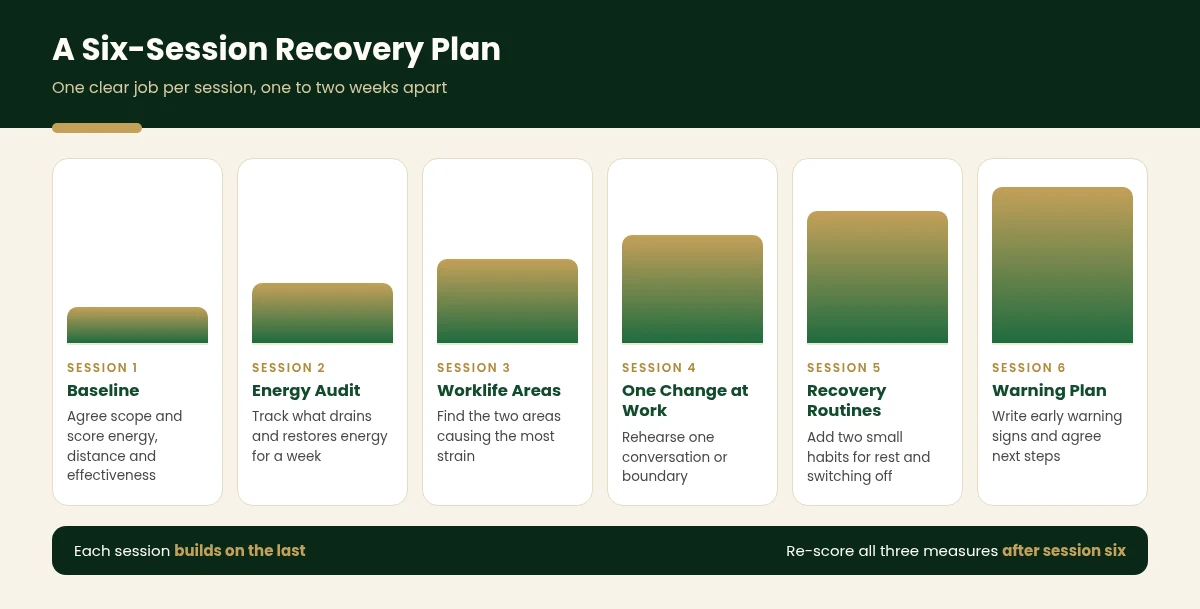
Use the table as your outline, then adjust it to each client's job and energy.
| Session | Focus | What the Client Takes Away |
|---|---|---|
| 1 | Baseline and agreement | Agreed scope, scores from 1 to 10 for energy, detachment and effectiveness, and one goal |
| 2 | Energy audit | A week of notes on what drains and what restores energy |
| 3 | Six areas of worklife | The two areas causing the most strain right now |
| 4 | One change at work | A rehearsed conversation or boundary to try before the next call |
| 5 | Recovery routines | Two small habits for sleep, breaks or switching off |
| 6 | Warning signs and next steps | A written early warning plan and a decision about what comes next |
After session six, score the same three measures again and compare them with the baseline. Some clients stop there. Others book a monthly check-in or a second block focused on a career move.
In burnout coaching, tired clients need questions that are short, concrete and kind. Avoid big "why" questions early on, because they can sound like blame to someone who already feels they are failing.
Write down the client's exact words. Reading them back in later sessions shows progress more clearly than any score.
Hearing about exhaustion all day can wear you down too. A stress and burnout coach needs the same limits they teach, or the work slowly becomes the problem it is meant to solve.
Start by capping the number of burnout clients you see in a single day. Leave time between sessions to write notes and reset, even if it means one fewer call.
Keep regular supervision or peer support in your calendar, and turn down clients who need more than coaching can offer. Most of all, watch for your own early warning signs and act on them quickly.
Burnout clients look for someone who understands their world, so start where your chosen group already spends time. Keep your message specific, such as helping new nurse managers handle their workload without dreading every shift.
Your own network: Tell former colleagues in your field what you now offer and who it is for.
Workplaces: HR teams and managers sometimes fund a workplace burnout coach for staff, especially for short programs with clear goals.
Referral partners: Doctors, therapists and career coaches may refer clients who need practical support alongside their care.
Helpful content: Short posts about early signs and small recovery habits show people how you think.
A coaching platform: Joining one lets clients who are actively searching for support find and book you.
You can find more tactics on how to get coaching clients.
Muse is a coaching platform built for independent coaches, and its terms suit coaches who offer burnout coaching. You work as a 1099 contractor with no exclusivity, so you can keep your own practice and bring existing clients with you.
Less admin leaves more energy for your clients, which matters in this niche more than most.
If that sounds like the right fit, you can become a Muse coach and start with the clients who suit you.
Burnout coaching rewards patience more than polish. Build your core skills, learn how burnout develops, write a clear referral line and begin with a six-session program for a group you understand.
Each client you help recover teaches you something the next one will need. Keep learning, keep your own energy protected and keep the line between coaching and care clear.
These short answers cover what aspiring coaches ask most often about this work.
Do You Need a Certification to Become a Burnout Coach?
No law requires one to coach in most of the US. Core coach training and burnout study still matter, because clients and employers want proof that you know your limits. A burnout coach certification can help with workplace contracts, but supervised practice and a clear referral plan matter more.
What Is the Difference Between a Burnout Coach and a Therapist?
A therapist is licensed to assess and treat mental health conditions, including depression and anxiety. A burnout coach helps clients who are coping with daily life change their workload, habits and decisions. Many clients benefit from both, as long as each professional stays in their own role.
How Long Does Burnout Coaching Take?
Many programs run six to twelve sessions over two to six months. The physician trials used six sessions over three to five months and still found clear drops in burnout. Recovery speed depends on how severe the burnout is and how much the client can change at work.
Can a Life Coach Offer Burnout Coaching?
Yes, many life coaches and career coaches already work with clients who are burned out. Add focused study on burnout, a written referral plan and regular supervision before you market yourself as a burnout recovery coach. That combination keeps clients safe and builds trust.
Who Hires a Burnout Coach?
People in demanding jobs hire burnout coaches most often, including healthcare workers, teachers, managers and founders. Some employers also pay for burnout coaching as a staff benefit. Clients usually want help to recover, reset their workload or decide whether to stay in their role.
Can Burnout Coaching Be Done Online?
Yes. Video sessions suit burnout coaching well because tired clients do not need to travel, and the JAMA peer coaching trial held its sessions by phone or video. Choose a quiet, private space and keep sessions on time to respect the client's energy.

